


Why Measuring AI ROI Isn’t Optional for SMBs
For small to mid-sized businesses, every marketing dollar and hour spent must deliver tangible results. Investing in AI tools without a clear path to measure their impact is a gamble few can afford. This isn’t about adopting the latest tech for its own sake; it’s about leveraging AI to solve specific business problems, reduce costs, or increase revenue. Proving the value of AI in marketing isn’t just good practice; it’s essential for justifying investment, optimizing your strategy, and ensuring your limited resources are allocated effectively.
This article will guide you through a pragmatic approach to measuring AI’s return on investment, focusing on what truly matters for lean teams operating under real-world constraints. You’ll learn how to prioritize metrics, set up a simple measurement framework, and communicate the value of your AI initiatives to drive further growth.
Prioritizing Metrics: What Actually Matters
When measuring AI’s impact, the temptation can be to track everything. For SMBs, this is a trap. Your goal is to identify a few key metrics that directly tie to your business objectives and can be realistically measured with your existing tools and team capacity. Avoid complex, multi-touch attribution models or vanity metrics that don’t directly inform decision-making.
Cost Reduction: This is often the easiest win to measure. Think about time saved on content creation, ad optimization, or customer service tasks. Quantify the hours saved and convert that into a monetary value based on team salaries or contractor rates.
Revenue Increase: Look for direct lifts in conversion rates, average order value (AOV), lead quality, or sales volume attributable to AI-powered initiatives. This requires careful setup, often through A/B testing.
Efficiency Gains: While related to cost reduction, this focuses on doing more with the same or fewer resources. Examples include faster campaign setup, increased content output, or reduced manual errors. These often translate to cost savings indirectly.
What should be deprioritized or skipped today? For most small to mid-sized teams, attempting to build a perfect, all-encompassing attribution model for every AI touchpoint is a significant drain on resources with diminishing returns. Instead, focus on direct, measurable impacts where the AI’s influence is clear. If you’re using AI for ad copy, measure the ad performance. If it’s for customer service, track ticket resolution times. Don’t get lost in trying to isolate AI’s fractional impact on a customer journey that involves dozens of other variables; that’s a luxury for larger enterprises with dedicated data science teams.
While the immediate metrics like cost reduction and efficiency gains are compelling, it’s easy to overlook the downstream effects of unchecked AI implementation. For instance, an over-reliance on AI for content generation might deliver initial speed, but without careful human oversight, it can subtly dilute your brand voice or produce generic messaging that fails to resonate deeply with your audience over time. This isn’t an immediate cost, but a slow erosion of brand equity that’s far harder to quantify until it’s a significant problem.
Another common pitfall is underestimating the ongoing human effort required to make AI truly effective. The promise of “automation” often translates to “AI-assisted” workflows in practice. Teams frequently discover that prompt engineering, reviewing outputs for accuracy and tone, and continuously refining the AI’s performance demands significant time and skill. This isn’t a one-time setup; it’s an iterative process that adds a new layer of work, often leading to frustration when initial expectations of a “set it and forget it” solution aren’t met.
Furthermore, focusing solely on quantitative metrics like output volume or speed can mask qualitative issues. AI might generate more content or handle more customer inquiries faster, but if the quality of that content is lower, or if the customer interactions lack empathy or true problem-solving, the initial efficiency gains can be offset by reduced engagement, higher churn, or a damaged reputation. The true impact isn’t just in doing more, but in doing more effectively and appropriately for your specific business context.
Setting Up Your Measurement Framework
Before you even deploy an AI tool, establish clear baselines. What are your current costs, conversion rates, time spent on specific tasks, or customer satisfaction scores? Without a baseline, you can’t accurately assess improvement. Once AI is implemented, track changes against these baselines.
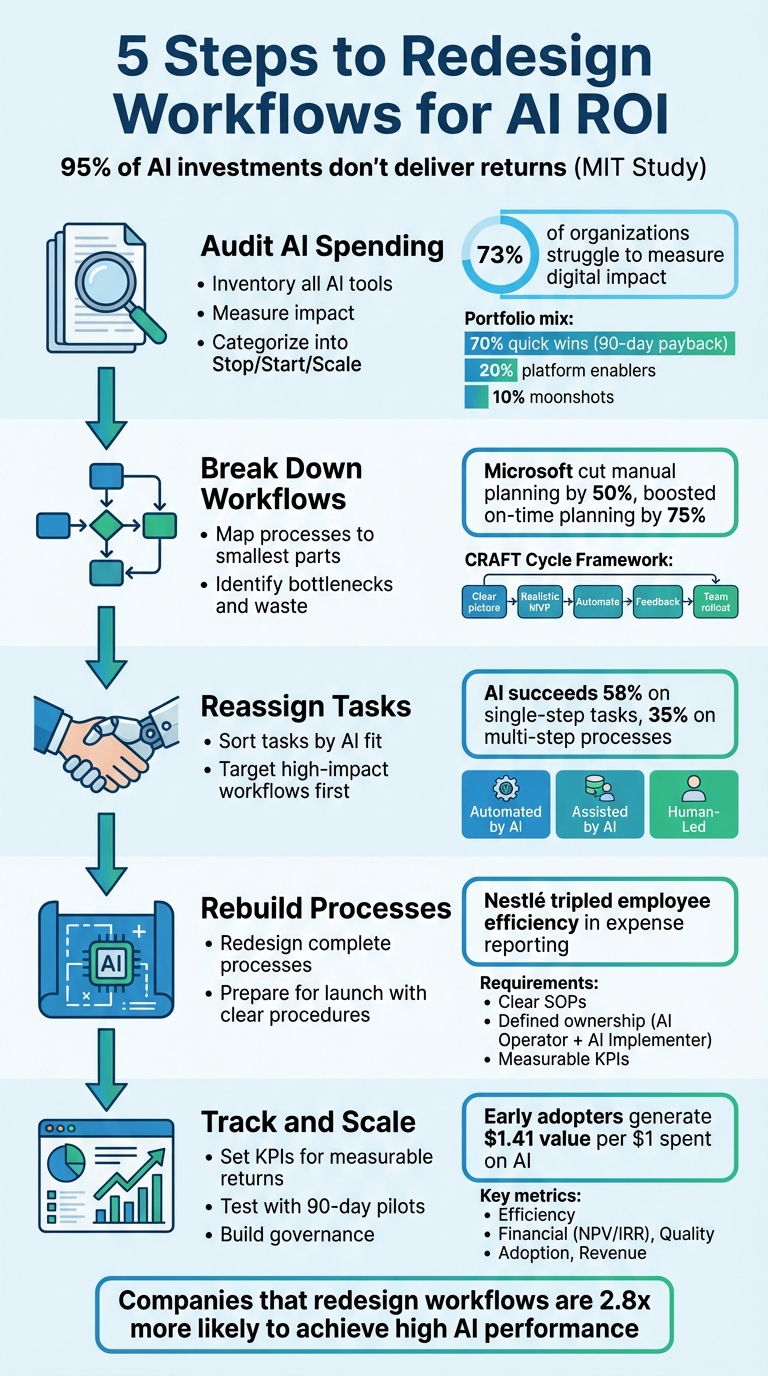
You don’t need specialized AI ROI software. Your existing analytics platforms (like Google Analytics 4), CRM dashboards, and even simple spreadsheets are often sufficient. The key is consistency in data collection.
Direct Attribution: Whenever possible, set up experiments where AI is the primary variable. For instance, run A/B tests comparing AI-generated ad copy against human-generated copy, or AI-optimized landing pages against standard ones. This provides the clearest picture of AI’s direct impact.
Controlled Experiments: If direct A/B testing isn’t feasible, consider controlled rollouts. Implement AI in one segment of your marketing efforts or for a specific product line, and compare its performance against a similar segment where AI is not used.
What often gets overlooked is the ongoing effort required to maintain the integrity of your measurement. Data quality isn’t a static state; it can degrade over time as sources change, new data streams are introduced, or human input varies. This ‘data drift’ can subtly skew your baselines and experiment results, making it difficult to trust your AI’s reported performance or accurately attribute its impact. Diagnosing this slow erosion of data fidelity requires consistent vigilance, which small teams often struggle to prioritize amidst daily operational demands.
Furthermore, while direct attribution is powerful for specific metrics, it rarely captures the full, second-order impact of AI. An AI tool might optimize for a conversion rate, but if the generated content or recommendations subtly deviate from your brand voice or customer experience standards, it can lead to a fragmented brand identity or a less authentic interaction over time. These qualitative, long-term consequences are difficult to quantify in a short-term A/B test and represent a hidden cost that can erode customer trust or brand equity, even as immediate metrics appear to improve.
Finally, the human element of interpretation and iteration is a significant, often underestimated, challenge. Even with clear data, understanding *why* an AI performed a certain way, or *how* to refine its output beyond simple A/B test results, demands deep analytical work and qualitative insight. Small teams often face immense pressure to demonstrate quick ROI, which can lead to an over-reliance on easily measurable outcomes and a deprioritization of the nuanced understanding needed for strategic iteration. This can foster frustration, creating a ‘black box’ perception of the AI, and ultimately limit its long-term strategic value.
Practical Scenarios and What to Track
AI for Content Creation (e.g., blog posts, social media copy)
Time Saved: Track the average time it takes to produce a piece of content with AI assistance versus without. This is a direct cost reduction.
Content Volume: Can you produce more high-quality content with the same team? More content often means more organic reach.
Performance Metrics: For AI-assisted content, monitor organic traffic, keyword rankings, social media engagement, or lead generation rates. Compare these to non-AI content performance. Prioritize efficiency first, then quality and performance.
AI for Ad Campaign Optimization (e.g., bidding, audience segmentation)
Cost Per Acquisition (CPA): Compare CPA for AI-optimized campaigns against manually managed campaigns or historical benchmarks.
Return on Ad Spend (ROAS): A critical metric. Did the AI-driven optimization lead to a higher ROAS?
Conversion Rate: Did the AI improve the conversion rate of your ads or landing pages? Direct impact on ad spend efficiency is often the easiest to prove here.
AI for Customer Service/Chatbots
Reduction in Support Ticket Volume: How many common queries are resolved by the chatbot without human intervention?
Faster Resolution Times: Does the AI help customers find answers more quickly?
Customer Satisfaction (CSAT): If you have a system to measure it, track CSAT scores for AI-assisted interactions versus human interactions. Focus on cost savings and improved customer experience.
AI for Personalization (e.g., website, email)
Conversion Rate Lift: Use A/B tests to compare conversion rates for personalized experiences versus generic ones.
Average Order Value (AOV): Does personalization lead to customers buying more?
Click-Through Rates (CTR): For personalized email campaigns or website recommendations. This often requires careful A/B testing to isolate AI’s impact.
Communicating Value and Iterating
Once you have data, present your findings clearly to stakeholders. Focus on the business impact: dollars saved, revenue generated, or time freed up for strategic work. Use simple, direct language. For example,


3 Comments