


Prioritizing AI for Immediate Content Wins
For teams with limited bandwidth, the most effective approach to AI in content creation is to target tasks that are repetitive, time-consuming, or prone to writer’s block. Focus on tools that deliver quick, measurable improvements without demanding a complete workflow overhaul.
- Idea Generation and Outline Creation: AI excels at brainstorming variations and structuring content. This is a low-risk, high-reward starting point. Tools can quickly generate blog post ideas, social media prompts, or video scripts based on keywords or topics, providing a solid foundation for human creativity.
- First Drafts and Boilerplate Content: For routine content like product descriptions, email subject lines, or basic blog post sections, AI can produce a robust first draft. The value here isn’t publishing AI-generated content verbatim, but eliminating the blank page syndrome and providing a foundation for human refinement.
- Content Repurposing: Transforming a long-form article into social media snippets, email newsletters, or video scripts is a significant time-saver. AI tools can efficiently extract key points, summarize, and reformat content, maximizing the reach of your existing assets.
- SEO Optimization Support: While not a replacement for human SEO expertise, AI can assist with keyword research suggestions, meta description generation, and even provide basic content optimization recommendations based on target keywords. This augments existing tools like Ahrefs or Semrush, enhancing efficiency rather than replacing strategic insight.
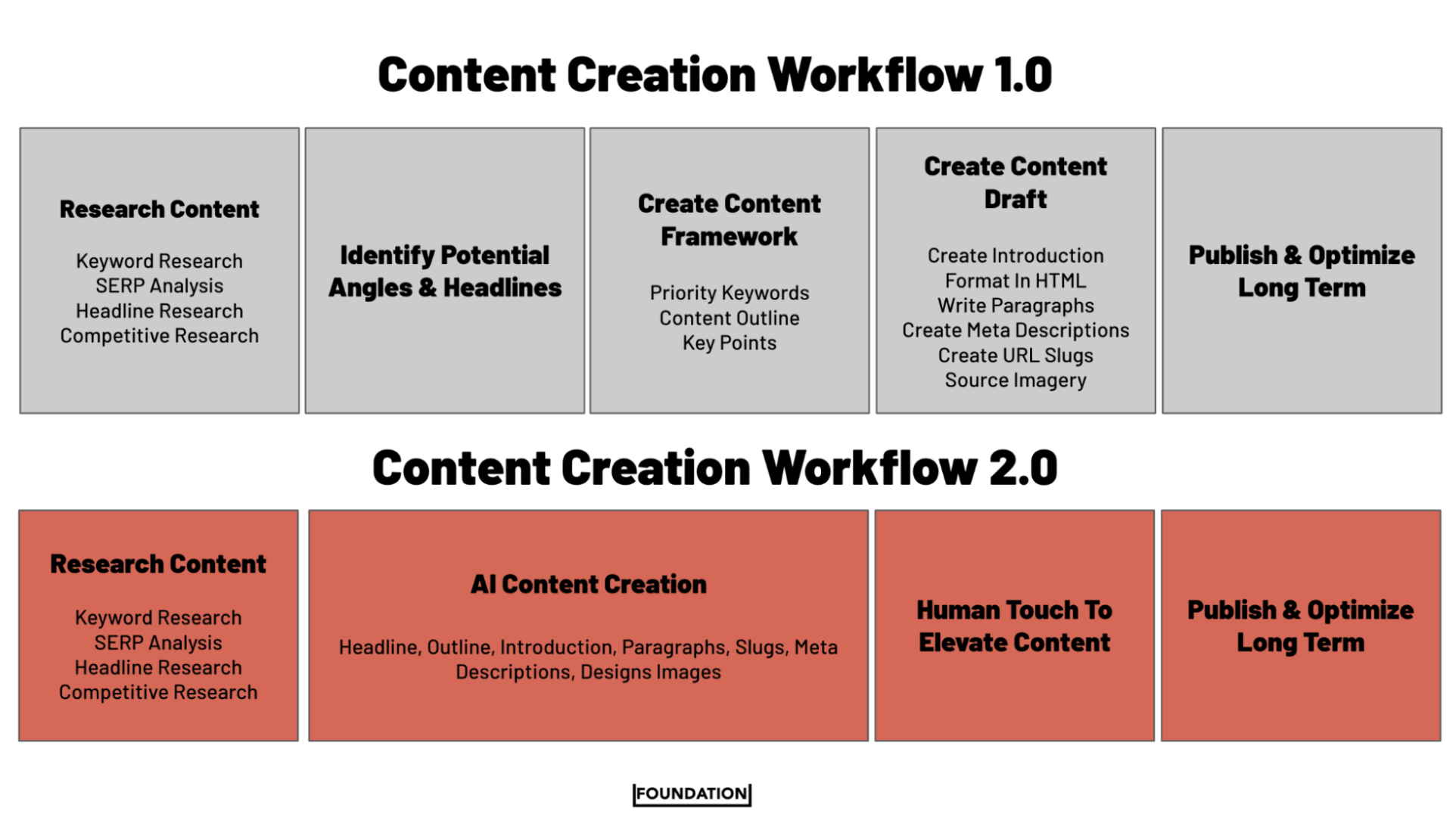
Strategic Integration: Where AI Truly Augments Your Workflow
Integrating AI effectively means fitting it into your existing content workflow, not overhauling it. The goal is to make your current processes more efficient, allowing your team to focus on strategic thinking and creative execution.
- Augmenting Human Creativity: Think of AI as a co-pilot. It can provide diverse perspectives, suggest angles you might have missed, or help overcome writer’s block. The human marketer remains the editor, the strategist, and the ultimate voice of the brand.
- Data-Driven Content Insights: Advanced AI tools can analyze content performance data to suggest topics, formats, or even optimal publishing times. This moves beyond basic analytics to predictive insights, helping small teams make smarter decisions with limited data analysis resources.
- Personalization at Scale: For email marketing or website content, AI can help tailor messages to different audience segments more efficiently than manual methods. This is particularly valuable for e-commerce businesses or those with diverse customer bases, enabling more relevant communication. AI for personalized marketing
However, the promise of augmentation often comes with hidden costs and non-obvious failure modes. Relying too heavily on AI for initial drafts, for instance, can subtly erode a team’s core creative muscle over time. The constant need to edit and refine AI-generated content that misses brand nuance or strategic intent can become more frustrating and time-consuming than starting from a blank page, leading to a form of creative atrophy rather than true augmentation. This isn’t just about efficiency; it’s about maintaining the unique human touch that defines a brand’s voice.
Furthermore, the “data-driven insights” AI offers are only as robust as the data feeding them. For small teams with imperfect or incomplete data sets, AI can amplify existing biases or generate misleading recommendations. The effort required to clean, structure, and validate data for AI consumption is often underestimated, creating a significant operational burden. Teams can also feel pressured to act on these AI-generated insights, even when their practitioner judgment suggests otherwise, leading to off-strategy content or wasted resources.
In practice, the seamless integration of AI into existing workflows is rarely as smooth as it sounds in theory. Each new AI solution often means another interface to learn, another set of permissions to manage, and potential friction points with existing systems. For teams already stretched thin, the overhead of managing these integrations can outweigh the benefits. It’s often more pragmatic to deprioritize deep, complex AI integrations in favor of using AI for specific, high-impact tasks where the human oversight remains strong, such as initial brainstorming or basic content repurposing. Chasing full automation across the board can quickly become a resource drain that distracts from core marketing objectives.
What to Deprioritize or Avoid Today
For small to mid-sized teams, the biggest pitfall with AI is overcomplication and chasing every new feature. Resource constraints demand a focused approach. Prioritizing what to not do is as critical as deciding what to implement.
Avoid custom AI model development. Unless you have dedicated data science resources and a significant budget, developing custom AI models for content generation is a massive drain on resources with little immediate ROI. Focus on off-the-shelf, proven tools that solve specific problems. Similarly, don’t over-automate your brand voice. While AI can mimic styles, it struggles with true brand voice, nuance, and emotional resonance. Relying solely on AI for high-stakes, brand-defining content risks diluting your unique identity. Human oversight and final editing are non-negotiable for anything customer-facing.
Furthermore, delay complex AI-powered content audits. While appealing, comprehensive AI content audits that promise deep insights into every piece of content can be resource-intensive to implement and interpret. For smaller teams, a focused, manual audit of top-performing and underperforming content, augmented by basic AI summarization, is more pragmatic. Prioritize fixing obvious gaps before investing in complex analytical systems. Finally, beware of “set-and-forget” AI. AI tools are not magic bullets. They require ongoing human input, refinement, and strategic direction. Assuming an AI tool will autonomously generate high-quality, on-brand content without supervision is a recipe for mediocrity and potential brand damage.
One often-overlooked consequence of readily available AI content generation is the temptation to simply produce more content. While the initial appeal is increased output, this can quickly lead to a ‘content treadmill’ effect. Teams find themselves generating a higher volume of pieces without a corresponding increase in strategic value or audience engagement. The hidden cost here is not just the AI subscription, but the increased internal overhead for review, editing, publishing, and promotion of a larger, potentially diluted content library. This dilutes focus and makes it harder for truly impactful content to stand out.
Another subtle pitfall is the gradual erosion of human judgment and skill. When AI consistently handles initial drafts or ideation, team members can become less adept at critical thinking, nuanced phrasing, and developing unique angles from scratch. This isn’t about replacing humans, but about the risk of dulling the very skills that differentiate human-crafted content. Furthermore, resist the internal or external pressure to constantly experiment with every nascent AI feature. Many new capabilities are still in beta or lack the stability and predictability required for reliable business operations. Chasing these unproven features often consumes valuable time in troubleshooting, re-learning, and adapting to frequent changes, diverting resources from established, effective workflows.
Measuring Impact and Refining Your AI Strategy
When integrating AI, focus on tangible improvements. It’s not enough to just use the tools; you need to know if they’re moving the needle for your business.
- Focus on Key Metrics: Track specific outcomes. Are you producing more content with the same headcount? Is content velocity increasing? Are engagement rates improving due to better-optimized or personalized content? Quantify the time saved on specific tasks.
- Iterative Approach: Start small. Implement AI for one specific task, measure its impact over a defined period, and then expand. This allows for quick adjustments and prevents large-scale disruptions or wasted investment.
- Establish Feedback Loops: Continuously feed human feedback into the AI tools. The more you guide and refine the AI’s output, the better it becomes at understanding your brand’s specific needs and style. This is a partnership, not a delegation.
The Indispensable Human Touch
Even with advanced AI, the core of effective content creation remains human. AI tools are powerful assistants, but they lack genuine creativity, empathy, and the ability to understand complex human emotions or cultural nuances. Your team’s unique insights, strategic thinking, and ability to connect with your audience on a human level are irreplaceable. AI handles the heavy lifting of repetitive tasks, allowing your marketers to focus on what truly differentiates your brand: authentic storytelling and strategic impact. This strategic partnership ensures your content not only performs but also resonates.


1 Comment