

Introduction
Understanding the true value of your AI investments is critical, especially for small to mid-sized businesses operating with tight budgets and lean teams. This playbook cuts through the hype to provide a pragmatic framework for measuring return on investment (ROI) and continuously optimizing your AI tools. You’ll gain clear guidance on what to prioritize, what to delay, and how to make AI a tangible asset rather than a costly experiment.
Our focus is on actionable strategies that deliver real-world results, helping you make informed decisions that align with your operational realities and drive measurable business growth.
Why Measuring AI ROI is Different (and Harder)
Unlike traditional software, AI tools often deliver value through indirect improvements: increased efficiency, better decision-making, or enhanced customer experiences. For SMBs, this complexity is compounded by limited data science expertise, imperfect data quality, and the rapid evolution of AI capabilities. Attributing specific revenue gains or cost savings directly to an AI tool can be challenging, requiring a shift from simple cost-benefit analysis to a more nuanced approach that considers both direct and indirect impacts.
The goal isn’t perfect precision, but rather sufficient clarity to make sound investment and optimization decisions.
What often gets overlooked in the initial excitement is the sustained operational burden AI places on data. Unlike a static software installation, AI models are living systems that require a continuous diet of clean, relevant data to maintain performance. The upfront effort to prepare data for initial training is only the beginning; the ongoing process of data hygiene, integration, and validation is a hidden cost that can quickly erode ROI if not properly resourced. When this continuous data feeding is deprioritized, models drift, outputs become less reliable, and the initial efficiency gains turn into a source of frustration and distrust within the team.
Another common pitfall is underestimating the human element. While AI promises automation, many practical applications for SMBs still require significant human oversight and interaction. This isn’t just about training staff on a new interface; it’s about integrating AI outputs into existing decision-making processes, validating its suggestions, and providing the feedback loops necessary for continuous improvement. The cost of this human-in-the-loop process—in terms of training, workflow adjustments, and the mental load on employees—is rarely factored into initial projections. When teams are forced to absorb this additional workload without adequate support, the promised efficiency can transform into operational friction and decision paralysis.
Finally, the pursuit of theoretical perfection can become a significant drag. There’s a natural inclination to strive for pristine data sets or to wait for the “ideal” AI solution that promises full autonomy. For SMBs operating with real-world constraints, this often leads to analysis paralysis or over-investment in complex infrastructure that outstrips immediate needs. A more pragmatic approach acknowledges that imperfect data, combined with informed human judgment, can still deliver substantial, incremental value. The decision to delay implementation while chasing an elusive ideal often means missing out on earlier, more achievable returns and can lead to a perception that AI is more trouble than it’s worth.
Defining Success: Metrics That Matter for SMBs
Before you can measure ROI, you must define what ‘success’ looks like for each AI application. For small and mid-sized teams, focus on metrics that directly tie to operational efficiency, customer engagement, or revenue generation. Avoid vague KPIs; instead, pinpoint specific, measurable outcomes.
- Time Saved: For content generation, customer support automation, or data analysis tasks. Quantify hours saved per week/month.
- Cost Reduction: Lower ad spend for similar results, reduced manual labor costs, or fewer errors.
- Lead Quality & Conversion Rates: Improved lead scoring, personalized outreach leading to higher conversion rates.
- Customer Satisfaction (CSAT) & Retention: Faster response times, more relevant recommendations, reduced churn.
- Operational Accuracy: Reduced errors in inventory management, forecasting, or data entry.
These metrics, while sometimes requiring estimation, provide a tangible basis for evaluating an AI tool’s contribution.
While ‘time saved’ is a critical metric, its real-world impact often falls short of theoretical projections. Simply freeing up hours doesn’t automatically translate into those hours being reallocated to higher-value, strategic work. More often, that ‘saved’ time gets absorbed by other low-priority tasks, or by the new overhead of managing the AI itself – reviewing outputs, correcting subtle errors, or prompting for revisions. The net gain in productive capacity can be far less than the initial calculation suggests, leading to a quiet erosion of perceived value over time.
Another common oversight is the ongoing cost of maintaining and integrating AI solutions. Initial cost reduction calculations rarely factor in the continuous effort required for API management, data pipeline adjustments, model monitoring for drift, or retraining staff as features evolve. These aren’t one-time setup costs; they are recurring operational expenses that can quietly negate early efficiency gains. Teams often find themselves dedicating significant resources to ‘feeding and caring’ for the AI, which wasn’t part of the original ROI projection.
Furthermore, while AI can reduce certain types of human error, it often introduces new, more insidious failure modes. Instead of obvious data entry mistakes, you might encounter subtle biases in lead scoring, ‘hallucinations’ in generated content, or skewed analytical insights that are harder to detect and correct. The burden then shifts to the human team to develop new auditing processes and maintain a higher level of vigilance, which can be a source of significant frustration and decision pressure. Trust in the AI’s output can erode quickly if the team constantly finds itself correcting its ‘smart’ mistakes, making the overall process feel more complex, not less.
The Practical ROI Calculation Framework
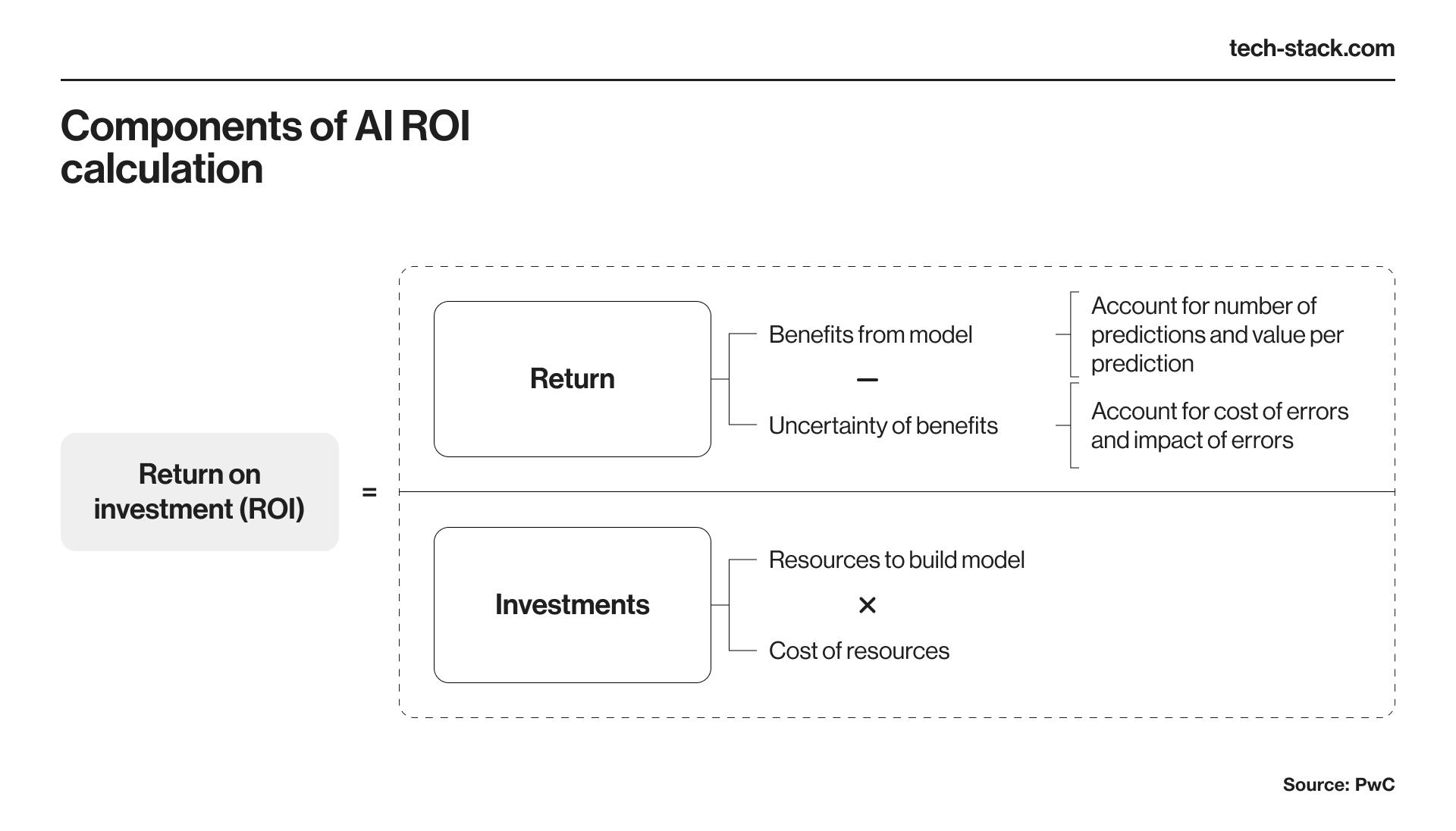
Calculating AI ROI for SMBs involves a blend of direct costs and estimated benefits. It’s less about a perfect formula and more about a consistent, pragmatic approach.
- Identify All Costs:
- Direct Costs: Software subscriptions, API usage fees, integration services.
- Indirect Costs: Employee training time, data preparation and cleaning efforts, ongoing monitoring and prompt engineering.
- Quantify Benefits:
- Translate your defined success metrics into monetary value. For example, if an AI tool saves ten hours of a marketing manager’s time per week, multiply that by their hourly rate. If it improves lead conversion by two percent, estimate the additional revenue generated.
- Be conservative in your estimations, especially initially.
- Calculate ROI:
ROI = (Total Monetary Benefits - Total Costs) / Total Costs
This framework provides a clear, if sometimes estimated, picture of your AI investment’s performance. Regular recalculation is essential as benefits and costs evolve.
Prioritizing Your AI Investments: Where to Start
With limited resources, strategic prioritization is non-negotiable. For SMBs, the best starting point for AI adoption often lies in areas that offer high impact with relatively low implementation complexity and risk. Focus on augmenting existing workflows rather than replacing entire systems.
- Internal Efficiency Gains: Prioritize AI for tasks that are repetitive, time-consuming, and prone to human error. Think content drafting, email response generation, or initial data analysis. These often have clear, measurable time-saving benefits.
- Customer Support Automation: Deploying AI chatbots for FAQs or initial triage can significantly reduce agent workload and improve response times, directly impacting CSAT.
- Marketing Personalization & Optimization: AI tools that refine ad targeting, personalize email campaigns, or analyze website visitor behavior can yield measurable improvements in conversion rates and ad spend efficiency.
Start with a pilot project, prove its value, and then scale. This iterative approach minimizes risk and builds internal confidence.
What to Deprioritize or Skip Today
Given the constraints of small to mid-sized businesses, it’s crucial to understand what AI initiatives to avoid or delay. Currently, deprioritize any bespoke AI development projects that require significant in-house data science expertise or custom model training. These carry high upfront costs, long development cycles, and substantial risk, often yielding uncertain ROI for teams without dedicated AI engineering resources.
Similarly, resist the urge to adopt every new AI “shiny object” without a clear, defined business problem it solves. Avoid tools that promise marginal gains in areas not critical to your core operations, or those that require extensive data cleanup before they can even function. Focus instead on off-the-shelf, proven AI applications that integrate relatively easily and address immediate, high-value pain points. Wasting resources on complex, unproven, or non-essential AI initiatives will only drain your budget and team morale.
Optimizing AI Performance: Beyond the Initial Launch
Deploying an AI tool is just the first step. True value comes from continuous optimization. This isn’t a ‘set it and forget it’ technology; it requires ongoing attention to maximize its effectiveness and ROI.
- Continuous Monitoring: Regularly track the metrics you defined for success. Are the time savings still there? Has the conversion rate held steady or improved? Use dashboards to visualize performance trends.
- Iterative Prompt Engineering: For generative AI tools, refine your prompts based on output quality and relevance. Small tweaks can lead to significant improvements in efficiency and accuracy.
- Feedback Loops: Gather feedback from the team members using the AI tools and from customers interacting with AI-powered features. Use this input to identify areas for improvement.
- Data Quality Improvement: AI models are only as good as the data they’re trained on or process. Invest in ongoing data hygiene and enrichment to ensure your AI tools are operating with the best possible inputs.
Treat AI optimization as an ongoing process, similar to how you’d manage a critical marketing campaign or sales funnel.
Sustaining AI Value: Iteration and Adaptation
The AI landscape is dynamic. To sustain the value of your AI investments, you must embrace a mindset of continuous iteration and adaptation. Regularly review your AI stack, assessing whether current tools still meet your evolving business needs or if newer, more efficient solutions have emerged. Train your team on new features and best practices, ensuring they can leverage AI effectively within their daily workflows. The goal is to embed AI as a strategic asset that grows with your business, rather than a static solution. This proactive approach ensures your AI investments continue to deliver measurable returns in the long term.



Leave a Comment