


For small to mid-sized marketing teams, the promise of AI isn’t about replacing roles; it’s about amplifying your existing capabilities. This article cuts through the hype to show you how to practically integrate AI tools to enhance your creativity, sharpen your strategic decisions, and optimize campaigns, even with tight budgets and lean operations.
You’ll gain actionable insights on prioritizing AI applications that deliver real value, understanding where human judgment remains critical, and identifying common pitfalls to avoid. The goal is to make your marketing efforts more effective and efficient, allowing your team to focus on high-impact, strategic work.
Prioritizing AI for Strategic Insights and Research
The most immediate and impactful application of AI for SMB marketers is in research and insight generation. Instead of spending hours manually sifting through data or brainstorming from scratch, AI can accelerate the foundational work, allowing you to move to strategic thinking faster.
- Audience Understanding: Use AI to analyze customer feedback, social media conversations, and demographic data to identify nuanced audience segments and pain points. This isn’t about AI telling you *who* your customer is, but helping you *understand* them deeper.
- Market & Competitor Analysis: Feed AI tools competitor content, ad copy, and website structures. It can quickly highlight common themes, gaps, and potential opportunities you might miss, informing your unique selling propositions.
- Content Idea Generation: Leverage AI to brainstorm blog topics, video scripts, or social media post ideas based on trending keywords and audience interests. Think of it as an infinite idea generator that you then filter and refine with your brand’s unique voice.
Augmenting Content Creation and Optimization Workflows
AI excels at generating initial drafts and optimizing existing content, significantly reducing the time spent on repetitive tasks. This frees up your team to focus on the creative refinement and strategic placement that only humans can provide.
- First-Draft Content Generation: For blog posts, email newsletters, or ad copy, AI can produce a solid first draft in minutes. This isn’t final copy; it’s a starting point that eliminates the blank page problem. Your team then edits, injects brand voice, and ensures accuracy.
- SEO Keyword & Topic Clustering: AI-powered tools can analyze search intent, group related keywords, and suggest content clusters more efficiently than manual methods. This ensures your content strategy is built on a solid foundation of what people are actually searching for. keyword research tools
- Personalized Messaging at Scale: AI can help tailor email subject lines, ad variations, or website copy based on user behavior or segment data. This allows for a level of personalization that’s often out of reach for smaller teams due to time constraints.
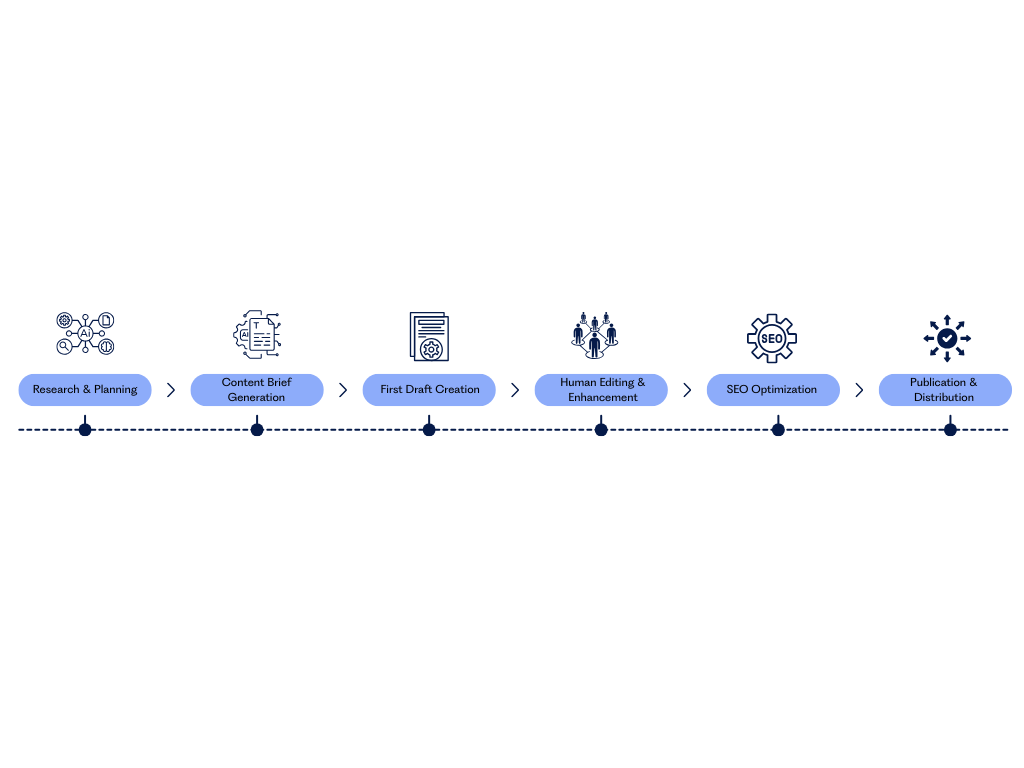
However, the efficiency gains from AI aren’t always straightforward. While AI excels at generating initial drafts, the quality can vary significantly. Teams often underestimate the substantial human effort still required to elevate an AI-generated draft from merely “functional” to truly on-brand and impactful. This isn’t just light editing; it frequently involves significant rewriting, fact-checking, and the critical injection of a distinct brand voice that AI cannot replicate. The perceived time savings can quickly erode if the team spends more time correcting or restructuring a poor AI output than they would have spent on an original human draft.
Furthermore, relying solely on AI for strategic tasks like keyword clustering or personalized messaging carries its own set of risks. AI is adept at identifying patterns in existing data, but it inherently lacks the human intuition to spot emerging trends, understand nuanced market shifts, or grasp the underlying “why” behind customer behavior. Over-optimization based purely on AI suggestions can lead to a content strategy that is technically sound but lacks true differentiation or foresight, potentially creating an echo chamber where content becomes generic and indistinguishable over time. The real value comes from human strategists interpreting AI insights, not just accepting them.
This dynamic also introduces a subtle pressure point for teams. The promise of AI-driven efficiency can inadvertently lead to a push for higher content volume, even if the human capacity for quality review and refinement isn’t scaling proportionally. This can result in a difficult trade-off: either publish more content with reduced human oversight, risking brand consistency and quality, or maintain quality at the expense of the promised volume. For most small to mid-sized businesses, the latter is the safer bet. It’s crucial to deprioritize blindly chasing content volume simply because AI makes it easier to produce. The long-term cost of publishing mediocre or off-brand content, regardless of its AI origin, far outweighs any short-term gains in output quantity.
Streamlining Campaign Management and Performance Analysis
AI tools can act as an invaluable assistant in managing campaigns and interpreting performance data, helping you make quicker, more informed decisions.
- Ad Campaign Optimization Suggestions: Many ad platforms now integrate AI to suggest bid adjustments, audience refinements, or budget reallocations based on real-time performance. While you maintain ultimate control, these suggestions can highlight opportunities you might overlook.
- Automated Reporting & Anomaly Detection: AI can generate performance reports and flag unusual spikes or drops in metrics, drawing your attention to areas that need investigation. This moves you from reactive data pulling to proactive problem-solving.
- A/B Test Idea Generation: Based on historical data, AI can suggest new hypotheses for A/B tests on landing pages, ad creatives, or email subject lines, helping you continuously improve conversion rates.
However, relying solely on AI suggestions without critical human oversight introduces its own set of challenges. While these tools excel at pattern recognition within existing data, they often lack the contextual understanding of your specific business goals, market nuances, or emerging trends that don’t yet have historical data. This can lead to optimizing for a local maximum, where incremental improvements are made within a narrow scope, potentially missing larger strategic opportunities or shifts that require a human to step back and re-evaluate the fundamental approach.
One common pitfall is the “black box” effect. When AI flags an anomaly or suggests an optimization, the underlying “why” is often opaque. This means the team still bears the burden of deep investigation to understand the root cause of a performance dip or to fully validate an AI’s recommendation. The time saved in initial detection can quickly be consumed by the diagnostic work, and without that human-driven diagnosis, acting on an AI suggestion can feel like a shot in the dark, leading to frustration and a lack of true learning within the team.
Furthermore, an over-reliance on automated suggestions can subtly erode a team’s critical thinking and strategic intuition over time. If practitioners consistently defer to AI, they may lose the muscle memory for independent analysis, hypothesis generation, and risk assessment. This second-order effect means that when the AI inevitably encounters a novel situation it hasn’t been trained on, or when its recommendations are simply off, the team might be less equipped to pivot effectively, leading to delayed consequences and suboptimal decision-making.
What to Deprioritize or Avoid Today
Given limited budgets and headcount, it’s crucial to be selective with AI adoption. Today, you should deprioritize or outright avoid fully automating complex strategic decisions without significant human oversight. Expecting AI to autonomously manage your entire brand voice, develop nuanced long-term strategies, or handle sensitive customer interactions without a human in the loop is a recipe for disaster. The cost of correcting AI-generated mistakes in these areas, both in terms of brand reputation and wasted resources, far outweighs any perceived efficiency gains. Focus on augmenting, not replacing, human judgment where brand integrity and strategic direction are paramount. Avoid investing heavily in niche, unproven AI tools that promise revolutionary results but lack clear, demonstrable ROI for SMBs; stick to widely adopted, reliable solutions first.
The Enduring Human Edge in Marketing
While AI excels at data processing, pattern recognition, and content generation, the core of effective marketing remains deeply human. Your team’s unique skills are not diminished but amplified by AI.
- Brand Voice & Storytelling: AI can draft, but only a human can truly imbue content with authentic brand personality, emotional resonance, and a compelling narrative that connects with an audience.
- Emotional Intelligence & Empathy: Understanding customer sentiment, building relationships, and navigating complex feedback requires human empathy and nuanced communication that AI cannot replicate.
- Complex Problem-Solving & Creative Strategy: AI can provide data and insights, but translating those into innovative, out-of-the-box campaigns that differentiate your brand requires human creativity, strategic foresight, and the ability to connect disparate ideas.
- Ethical Judgment & Brand Guardianship: Deciding what’s appropriate, ethical, and aligned with your brand’s values in marketing communications is a human responsibility. AI lacks the moral compass and contextual understanding to make these critical judgments. ethical AI marketing


Leave a Comment