

Understanding the “Why”: Strategic AI Adoption for SMBs
For small to mid-sized businesses, integrating AI isn’t about chasing the latest buzzword; it’s about making your existing marketing efforts more efficient and effective. The core “why” for AI adoption should always tie back to solving concrete operational pain points. Think about the repetitive, time-consuming tasks that drain your team’s energy, or the data analysis that’s too complex to tackle manually. AI tools, when integrated thoughtfully, can automate these processes, provide deeper customer insights, and enable personalization at a scale previously out of reach for lean teams. The goal isn’t a complete overhaul, but rather a strategic enhancement of your current capabilities to achieve measurable gains in productivity and campaign performance.
Starting Small: Identifying High-Impact Integration Points
The biggest mistake SMBs make with AI is attempting to integrate everything at once. This leads to overwhelm, wasted resources, and ultimately, failure. Instead, identify one or two specific areas where AI can deliver immediate, tangible value. Prioritize tasks that are highly repetitive, data-intensive, or crucial for rapid iteration. Consider these common starting points:
- Content Generation: Automating first drafts for blog posts, social media captions, or email subject lines. This frees up your content creators for strategic refinement.
- Ad Copy Optimization: Generating multiple ad variations and testing headlines based on performance data.
- Basic Customer Service: Implementing chatbots for frequently asked questions (FAQs) to offload support teams and provide instant responses.
- Email Segmentation & Personalization: Using AI to analyze customer behavior and segment audiences more effectively for targeted campaigns.
Decision: For most SMBs, the pragmatic approach is to start with a single, well-defined problem where AI can offer a clear, measurable improvement. Don’t aim for a grand transformation; aim for a practical, impactful win.
Even with seemingly straightforward applications like content generation, the initial output often requires significant human oversight. What looks like “automating first drafts” in theory can quickly become a bottleneck in practice if the human team isn’t prepared for the level of strategic refinement, fact-checking, and brand voice alignment required. The AI might generate text, but ensuring it resonates with your specific audience and upholds your brand’s unique perspective demands a different kind of effort—one that can be more mentally taxing than starting from scratch if the AI’s output is too generic or off-brand. This often leads to a hidden cost in increased cognitive load and potential frustration for content creators, who might feel more like editors of mediocre drafts than strategic communicators.
Similarly, deploying basic customer service chatbots for FAQs, while promising instant responses, carries a significant risk of delayed consequences if not managed carefully. The initial setup might seem simple, but the ongoing need for high-quality training data, continuous monitoring, and iterative refinement is frequently underestimated. A chatbot that provides inaccurate or unhelpful responses can quickly erode customer trust and escalate simple inquiries into more complex, frustrating interactions. This doesn’t just negate the efficiency gains; it can actively increase the workload for human support teams who then have to address the fallout from a poorly performing bot, turning an intended solution into a new problem.
Finally, while the directive to seek “clear, measurable improvement” is sound, the practical reality of defining and tracking these metrics can be challenging. It’s easy to focus on output volume (e.g., more ad variations, more content drafts) rather than true impact. Without robust testing frameworks, clear baseline data, and the analytical capacity to interpret results accurately, a “win” can remain ambiguous. Teams might find themselves generating more activity without a clear understanding of whether it’s actually driving better business outcomes, leading to decision pressure and a sense that the AI investment isn’t delivering its promised value.
Choosing Your AI Tools: An Integration-First Mindset
When selecting AI tools, their ability to integrate seamlessly with your existing marketing stack is paramount. A powerful AI tool that operates in a silo creates more problems than it solves, leading to manual data transfers, inconsistencies, and missed opportunities. Prioritize tools with robust native integrations or well-documented APIs that allow for smooth data exchange. Consider how new tools will connect with your CRM (e.g., HubSpot, Salesforce), email platform (e.g., Mailchimp, Klaviyo), analytics (e.g., Google Analytics 4), and project management systems.
Judgment: A slightly less feature-rich AI tool that integrates flawlessly with your current ecosystem will almost always outperform a “best-in-class” standalone solution that requires significant manual effort or custom development to connect. The friction of poor integration negates most AI benefits for resource-constrained teams.
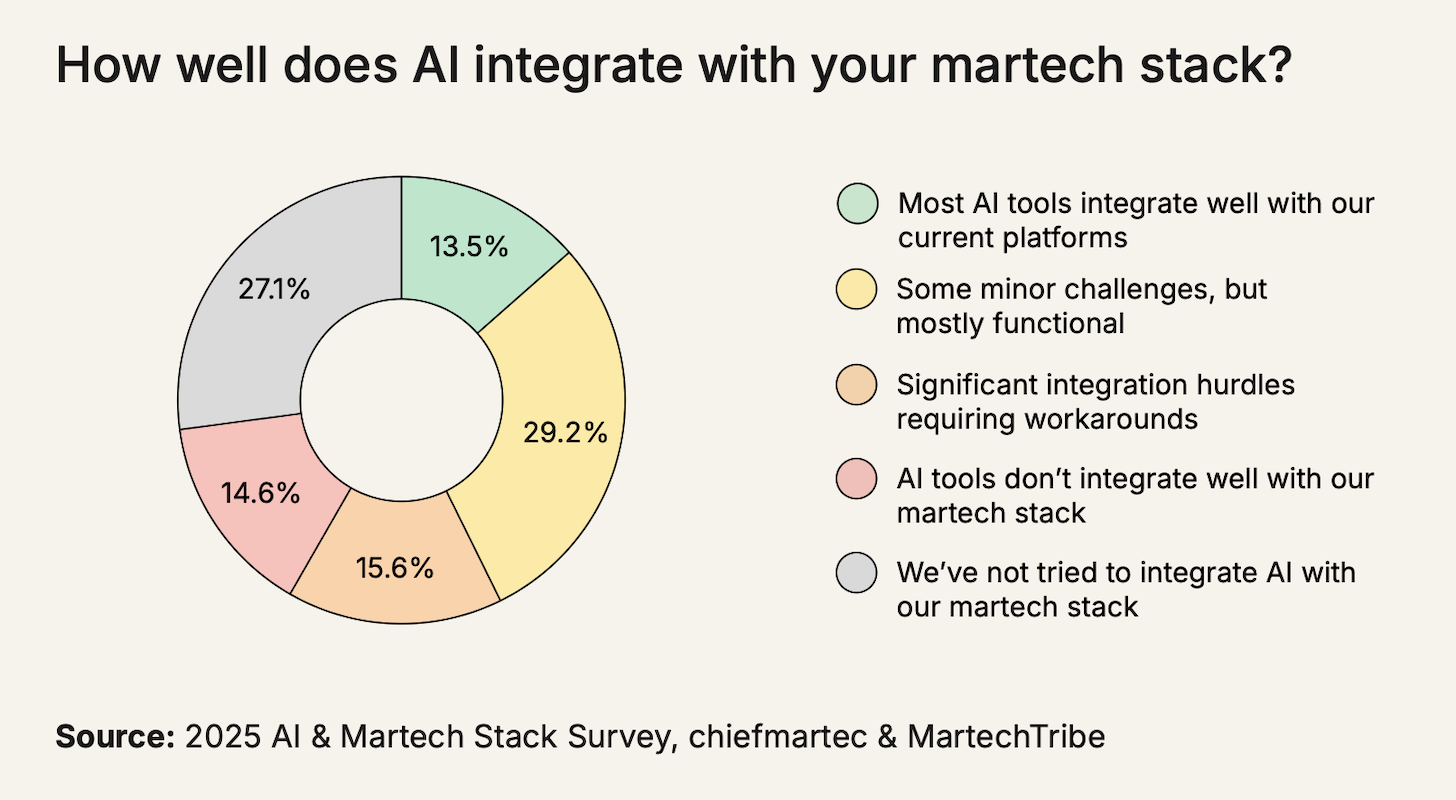
What often gets overlooked in the initial excitement of adopting a new AI capability is the insidious nature of ‘integration debt.’ A team might rationalize a few manual CSV exports or a quick Zapier connection as a temporary bridge. However, these stop-gap measures rarely remain temporary. They calcify into permanent operational overhead, consuming valuable team hours that could be spent on strategic work. This isn’t just about lost productivity; it’s a slow drain on morale, as team members repeatedly perform repetitive, error-prone tasks that the AI was supposed to eliminate.
Beyond the sheer effort, the quality and timeliness of data flowing between systems are critical. A connection might exist, but if it’s prone to delays, dropped fields, or requires constant manual validation, the insights generated by the AI become suspect. Teams start distrusting the data, which then undermines confidence in the AI’s recommendations. Furthermore, integrations aren’t static; APIs evolve, platforms update, and what worked flawlessly last quarter might silently break next. Without dedicated ownership for monitoring and maintaining these connections, data integrity erodes, turning a promising AI investment into a source of frustration and unreliable intelligence.
Seamless Data Flow: The Backbone of an AI Stack
AI models are only as good as the data they consume. Ensuring a seamless and secure flow of data between your marketing tools is critical for an effective AI stack. This means leveraging APIs, webhooks, and integration platforms like Zapier or Make.com to automate data transfer. Before introducing any new AI tool, map out your current data pathways. Understand where customer data, campaign performance metrics, and content assets reside, and how they need to move to feed your AI applications. Standardizing data formats where possible and maintaining clean, accurate data are non-negotiable. Garbage in, garbage out applies even more rigorously when AI is involved.
What to Deprioritize or Avoid Today
For small to mid-sized teams operating under real-world constraints, making smart trade-offs is essential. Here’s what you should actively deprioritize or avoid in your current AI integration efforts:
- Building Custom AI Models from Scratch: Unless you have dedicated data science expertise and a significant R&D budget, attempting to develop proprietary AI models is a resource black hole. Focus on leveraging robust, off-the-shelf AI solutions that are already proven and maintained by vendors.
- Complex, Multi-Tool AI Orchestration: Don’t aim for a fully autonomous, interconnected AI marketing brain on day one. Over-engineering your stack with intricate automations across dozens of tools will lead to complexity, fragility, and debugging nightmares. Start with specific, high-impact task automations and scale gradually.
- Tools Without Clear Integration Paths: If an AI tool promises groundbreaking features but lacks native integrations or a well-documented API, it will become an isolated island of data and effort. The manual work required to transfer data in and out will quickly negate any AI-driven efficiency gains. Prioritize tools designed for interoperability.
Focus your limited time and budget on practical, achievable integrations that deliver clear value, rather than chasing theoretical perfection or complex, unproven setups.
Measuring Impact and Iterating
Implementing AI tools is not a set-and-forget operation. To ensure your AI-powered marketing stack is truly delivering value, you must define clear Key Performance Indicators (KPIs) before deployment. What specific metrics are you aiming to improve? (e.g., a ten percent reduction in content creation time, a five percent increase in email open rates, a better return on ad spend). Regularly monitor these KPIs. AI models, especially generative ones, require ongoing oversight and refinement. Adjust prompts, fine-tune settings, and provide feedback to the systems. Treat AI integration as an iterative process of continuous optimization, not a one-time project. If an AI tool isn’t delivering tangible, measurable value within a reasonable timeframe, be prepared to pivot, adjust its application, or replace it with a more effective solution.



Leave a Comment