

Unlock Organic Growth with Topical Authority
For small to mid-sized businesses, competing for organic search visibility often feels like an uphill battle against larger players. This guide cuts through the noise, showing you how to strategically build topical authority using semantic SEO and content clusters. You’ll learn to prioritize your efforts, make smart trade-offs, and efficiently allocate your limited resources to genuinely improve your search rankings and attract more qualified traffic.
We’ll focus on practical steps that work in the real world, helping you demonstrate comprehensive expertise to search engines and your audience, even with imperfect execution and a lean team.
What is Topical Authority and Why It Matters for Your Business
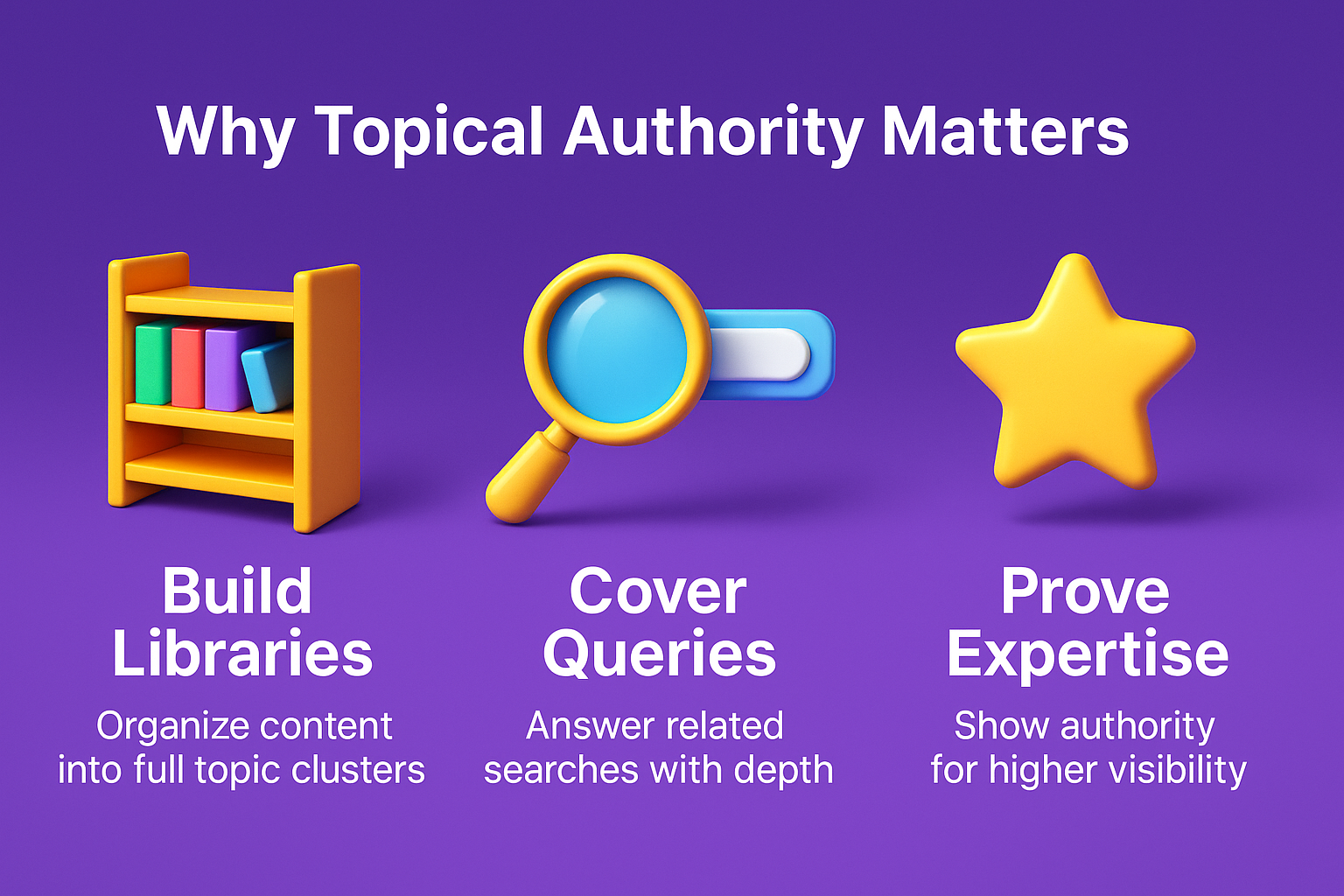
Topical authority isn’t just about ranking for a few keywords; it’s about demonstrating comprehensive expertise on a subject. When Google perceives your website as a go-to resource for a specific topic, it signals that you understand the nuances, related concepts, and user intent surrounding that subject. This isn’t a theoretical concept; it directly impacts your ability to rank for a wider array of relevant keywords and, crucially, to maintain those rankings.
For SMBs, this means more efficient content marketing. Instead of chasing individual keywords in isolation, you build interconnected content that reinforces your expertise. This approach helps you overcome the limitations of a small content team by making each piece of content work harder, collectively boosting your site’s overall relevance and trustworthiness in the eyes of search engines.
The initial shift from a keyword-centric to a topic-centric content strategy can feel counterintuitive and slow. Teams are often accustomed to seeing immediate, albeit often fleeting, gains from targeting specific high-volume keywords. Building topical authority, however, demands a longer view. The hidden cost isn’t just the upfront time investment, but the mental shift required to prioritize depth and interconnectedness over isolated keyword wins. This can lead to internal pressure and frustration when early metrics don’t spike, tempting teams to revert to less effective, short-term tactics.
A common pitfall is mistaking quantity for quality within a topic. Simply producing many articles around a subject without genuine depth or unique insight can dilute your authority rather than build it. This leads to a second-order problem: a bloated content library that’s difficult to manage, update, and internally link effectively. Instead of signaling expertise, it can signal superficiality, making it harder for search engines to discern your true value and for users to find what they need, ultimately undermining the very goal of topical authority.
What’s often overlooked in the pursuit of topical authority is the critical role of internal linking and content architecture. It’s not enough to just create the content; you must connect it logically and explicitly. Without a deliberate internal linking strategy, even well-researched, comprehensive content can exist in silos, failing to pass authority effectively between related pages. This requires ongoing discipline and a clear content taxonomy, which can be challenging to maintain as a site grows, especially for small teams juggling multiple priorities. The pressure to publish new content often overshadows the less glamorous, but equally vital, task of organizing and interlinking existing assets.
The Core: Semantic SEO and Content Clusters
At the heart of topical authority lies semantic SEO, which moves beyond exact keyword matching to understand the meaning and context behind search queries. It’s about covering a topic comprehensively, addressing all related subtopics and user questions.
Content clusters are the structural framework for achieving this. A cluster consists of a central, comprehensive “pillar page” that broadly covers a topic, supported by multiple “cluster content” articles that delve into specific subtopics in detail. These supporting articles link back to the pillar page, and the pillar page links out to the supporting articles, creating a web of interconnected content that signals deep expertise to search engines.
- Pillar Page: A broad, high-level overview of a core topic (e.g., “Digital Marketing Strategies”).
- Cluster Content: Detailed articles on specific subtopics that support the pillar (e.g., “SEO for Small Businesses,” “Social Media Advertising Basics,” “Email Marketing Automation”).
- Internal Linking: Strategic links connecting pillar to cluster and cluster to pillar, reinforcing topical relevance.
While the structural clarity of content clusters is appealing, the practical execution often hides significant challenges. One common pitfall is mistaking “comprehensiveness” for sheer volume. Teams can fall into a content factory mindset, producing numerous articles that technically fit a subtopic but fail to genuinely address distinct user intent or different stages of the buyer journey. The hidden cost here isn’t just the immediate resource expenditure on creation, but the long-term drag of maintaining, updating, or eventually pruning a large inventory of underperforming assets that dilute overall topical authority rather than strengthening it.
Furthermore, the initial effort of building out a cluster often overshadows the ongoing commitment required for its maintenance and evolution. Search engine algorithms and user expectations are not static; what constituted comprehensive coverage last year might be outdated or incomplete today. Neglecting regular content audits, updates, and strategic expansions means that the initial investment in a cluster can slowly decay, losing its competitive edge and signaling to search engines that the content is no longer the most relevant or authoritative. This isn’t a one-time build; it’s an ongoing stewardship.
Another area where theory diverges from practice is internal linking. While conceptually straightforward, managing a robust and effective internal linking strategy across a growing content cluster becomes increasingly complex. Teams often struggle with consistency, ensuring that new content is properly integrated, and that older links remain relevant and functional. Without a disciplined approach, the intended “web of interconnected content” can devolve into a confusing tangle of broken links or missed opportunities, diminishing the very signal of expertise it’s designed to convey. This operational overhead, if underestimated, can quickly become a source of frustration and a drag on overall SEO performance.
Prioritizing Your Topical Authority Strategy: What to Do First
With limited resources, prioritization is non-negotiable. Here’s a pragmatic approach to getting started:
- Identify Your Core Business Topics: Start with what you genuinely know best and what directly aligns with your products or services. Where can you realistically become a leading voice? Don’t try to cover everything.
- Perform Semantic Keyword Research: Use tools like Ahrefs or Semrush to identify not just individual keywords, but related terms, common questions, and user intent around your chosen core topics. Look for gaps where your competitors aren’t providing comprehensive answers. topic research tool
- Map Out Your First Pillar Content: Choose one broad, high-value topic that can serve as your initial pillar. This should be a topic with significant search volume potential and direct business relevance.
- Brainstorm Supporting Cluster Content: List out 5-10 specific subtopics that naturally fall under your chosen pillar. These will become your individual cluster articles. Focus on answering specific user questions or exploring niche aspects of the pillar topic.
Executing Your Content Cluster Build
Once you have your map, it’s time to build. Remember, quality over quantity, especially when starting out.
- Develop the Pillar Page First: Create a truly comprehensive, high-quality pillar page. This isn’t a blog post; it’s an authoritative resource that provides a strong overview and links to more detailed content. Aim for depth and utility.
- Create Cluster Content Systematically: Write your supporting articles, ensuring each one provides unique value and thoroughly covers its specific subtopic. As you write, think about how it connects to the pillar and other related cluster articles.
- Implement a Robust Internal Linking Strategy: This is critical. From each cluster article, link back to your pillar page using relevant anchor text. From your pillar page, link out to all supporting cluster articles. Also, look for opportunities to link between related cluster articles to further strengthen the network.
- Integrate Existing Content: Don’t just create new content. Audit your existing blog posts and articles. Can any be repurposed, updated, or integrated into your new clusters? This is often a faster path to building out a cluster than starting from scratch.
What to Deprioritize or Skip Today
For SMBs, resource allocation is paramount. Today, you should deprioritize chasing every trending keyword or attempting to build clusters for topics that are only tangentially related to your core business. Avoid the trap of trying to be comprehensive across too many disparate subjects. Your limited budget and headcount mean that a focused, deep dive into a few key topics will yield far better results than a shallow, broad approach. Don’t try to build five clusters simultaneously; start with one or two, prove their effectiveness, and then expand. Over-optimizing for exact match keywords is also a distraction; focus on natural language and genuinely answering user intent.
Measuring Success and Iterating
Building topical authority is an ongoing process. You need to track your efforts to understand what’s working and where to adjust.
- Organic Traffic: Monitor the organic traffic to your pillar and cluster pages. Look for overall increases, not just individual page performance.
- Keyword Rankings: Track rankings for both your broad pillar keywords and the more specific, long-tail keywords targeted by your cluster content. You should see improvements across a wider range of terms.
- Engagement Metrics: Analyze time on page, bounce rate, and pages per session for your cluster content. High engagement signals that your content is valuable and relevant.
- Google Search Console: Use GSC to identify new search queries your cluster pages are ranking for, potential content gaps, and opportunities to improve existing content.
Moving Forward with Topical Authority
Building topical authority isn’t a quick fix; it’s a strategic investment in your long-term organic growth. By focusing on semantic SEO and structuring your content into clusters, you’re not just playing Google’s game; you’re genuinely serving your audience with comprehensive, valuable information. This approach, while requiring upfront planning, ultimately leads to more sustainable rankings, higher quality traffic, and a stronger online presence for your small or mid-sized business.


Leave a Comment