

Navigating the AI Search Shift for SMBs
The landscape of online visibility is fundamentally changing with the rise of AI-powered search. For small to mid-sized businesses with limited resources, adapting isn’t optional; it’s critical for survival. This guide cuts through the noise, offering actionable strategies to optimize your content for AI search today, ensuring your business remains discoverable and relevant. You’ll learn where to focus your efforts, what content truly matters, and how to make pragmatic trade-offs to secure future visibility and drive growth.
By prioritizing specific content types and structural elements, you can position your brand to be favored by AI systems, leading to more direct answers, better featured snippets, and ultimately, more qualified traffic. We’ll focus on what works in real-world conditions, helping you make smart decisions despite operational constraints.
The Core Shift: From Keywords to Concepts and Answers
Traditional SEO often revolved around keyword density and exact match phrases. While keywords still play a role, AI search engines, like Google’s evolving Search Generative Experience (SGE), prioritize understanding user intent, semantic relationships, and delivering direct, comprehensive answers. This means your content must not just contain keywords, but genuinely answer questions, explain concepts thoroughly, and demonstrate authority on a topic.
AI models excel at synthesizing information from various sources to provide a concise, authoritative response. Your goal is to be one of those authoritative sources. This requires a shift from simply ranking for a term to being the definitive answer for a user’s query, regardless of how they phrase it.
The practical implication of this shift is a significant increase in the required investment. It’s not enough to have a writer; you need subject matter expertise. For many small to mid-sized businesses, this means either dedicating internal experts to content creation – pulling them away from other critical tasks – or investing heavily in external specialists. The cost isn’t just in words on a page, but in the deep research, validation, and synthesis needed to truly be definitive. This often gets overlooked in initial content planning, leading to under-resourced efforts that fall short of the “authoritative” bar.
A common pitfall is producing content that *feels* comprehensive to the human writer but lacks the depth or unique insight an AI model seeks. Generic overviews, even if well-written, won’t cut it. The AI’s ability to synthesize means it will favor sources that offer novel perspectives, proprietary data, or truly exhaustive explanations that go beyond surface-level information. If your content merely reiterates what’s already widely available, it risks being passed over, not just for direct ranking, but for inclusion in AI-generated summaries. This is a critical second-order effect: your content might exist, but it won’t be *seen* or *used* by the AI, effectively making it invisible in the new search landscape.
This new reality puts immense pressure on content teams, particularly those with limited headcount. The decision isn’t just about *what* to write, but *how deeply* to commit to each topic. Attempting to be authoritative across too many concepts with limited resources is a recipe for diluted effort and mediocre results. It’s often more effective to choose a smaller set of core topics where you can genuinely become the definitive source, even if it means deprioritizing broader keyword coverage. The frustration comes from the need to make these hard trade-offs, knowing that every topic not deeply covered is a missed opportunity in the AI-driven search environment.
Prioritizing Content for AI Search Visibility
For SMBs, every content effort must count. Here’s where to focus your limited resources:
- Deep, Authoritative Topic Hubs: Instead of creating many shallow articles, build comprehensive content hubs around core topics. Each hub should cover a subject exhaustively, linking related sub-topics. This signals deep expertise and authority to AI models. For example, if you sell marketing software, create a definitive guide to ‘Email Marketing Automation’ that covers everything from strategy to tool selection, rather than separate posts on ‘best email subject lines’ and ‘how to segment lists’.
- Clear, Concise Answers: Structure your content to provide direct answers to common questions. Use clear headings, bullet points, and summary paragraphs. AI often pulls these snippets for direct answers or generative summaries. Think about the ‘People Also Ask’ section and aim to answer those questions directly within your content.
- Demonstrate E-E-A-T (Experience, Expertise, Authoritativeness, Trustworthiness): This has always been important, but AI amplifies its significance. Ensure your content is written by or attributed to individuals with verifiable experience and expertise. Include author bios, credentials, and link to relevant professional profiles. For product pages, include detailed specifications, customer reviews, and clear return policies. This builds trust, a critical factor for AI systems evaluating content quality. E-E-A-T guidelines
- Structured Data (Schema Markup): Implement Schema.org markup wherever possible. This provides explicit context to search engines about your content, products, services, and organization. For example, marking up FAQs, product details, reviews, or local business information helps AI understand and present your data accurately. It’s a direct way to communicate with the machines.
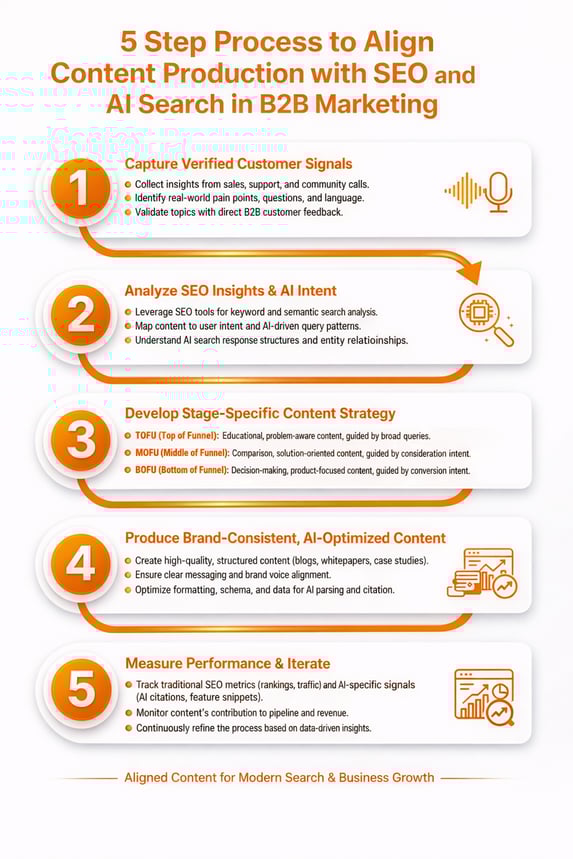
The initial investment in deep topic hubs is significant, but the real challenge for SMBs lies in ongoing maintenance. What’s authoritative today can be outdated tomorrow. This isn’t a one-time project; it’s a continuous commitment to accuracy and freshness. Overlooking this leads to content decay, where once-valuable assets become liabilities, signaling neglect to both users and AI systems. The internal friction of pulling busy subject matter experts away from core operations for regular content reviews is a constant source of frustration and a common bottleneck.
While optimizing for clear, concise answers is crucial for AI visibility, a common pitfall is to stop there. Content that perfectly answers a specific query but fails to provide deeper context, address follow-up questions, or guide the user towards a solution often falls short in driving business outcomes. The immediate win of a featured snippet can mask a deeper problem: content that attracts clicks but doesn’t convert. This creates a disconnect between search visibility metrics and actual business impact, leading to frustration when traffic doesn’t translate into leads or sales.
The emphasis on E-E-A-T, while critical, also introduces a practical dilemma for lean teams. It’s easy to overlook the human element required to genuinely demonstrate expertise and trustworthiness. Simply adding an author bio isn’t enough; the content itself must reflect genuine insight. This often means relying on internal experts who are already stretched thin. The pressure to publish frequently can lead teams to compromise on the depth of expert review, resulting in content that superficially meets E-E-A-T guidelines but lacks the true authoritative voice that builds lasting trust with both human readers and sophisticated AI models. This trade-off between speed and genuine authority is a constant decision point.
What to Deprioritize and Avoid Today
With limited budgets and headcount, making smart trade-offs is essential. Here’s what to delay or skip:
Deprioritize:
- Thin, Keyword-Stuffing Content: Content created solely to target a long list of low-volume keywords without offering substantial value. AI is sophisticated enough to see through this and will likely ignore or penalize it. Focus on quality over sheer quantity.
- Over-Optimization for Exact Match Keywords: While keywords are still relevant for initial discovery, obsessing over exact keyword density or placement is less effective. AI understands synonyms and semantic relationships. Focus on natural language and comprehensive topic coverage instead.
- Content Without a Clear Purpose: Every piece of content should serve a specific user need or business goal. If you can’t articulate why a piece of content exists and what problem it solves, it’s likely a waste of resources.
Avoid:
- Low-Quality, Unedited AI-Generated Content: While AI tools can assist in content creation, publishing raw, unedited, or unverified AI output is a mistake. It often lacks unique insights, E-E-A-T, and can contain inaccuracies. Human oversight, editing, and value addition are non-negotiable.
- Ignoring User Intent: Creating content that doesn’t genuinely address the underlying intent of a user’s query will lead to poor engagement and low visibility. Always ask:



Leave a Comment