

Understanding Hyper-Personalization for SMBs
Hyper-personalization isn’t about creating a unique website for every visitor; it’s about leveraging data and AI to deliver highly relevant content, offers, and experiences at scale. For small to mid-sized businesses (SMBs) with limited resources, this means moving beyond basic segmentation to truly understand individual customer behaviors and preferences. The goal is to make each customer feel seen and understood, leading to stronger engagement and higher conversion rates.
Practically, this involves using AI to analyze data points like past purchases, browsing history, email interactions, and demographic information to predict what a customer needs or wants next. It’s about tailoring the message, the channel, and the timing to maximize impact, rather than blasting generic campaigns to broad segments.
Core AI Capabilities to Prioritize
When budgets and headcount are tight, focusing on AI capabilities that deliver tangible results quickly is paramount. Don’t get lost in the hype of every new AI feature. Prioritize these core areas:
- Advanced Customer Segmentation: AI can uncover subtle patterns in your customer data that human analysis might miss. This allows for more granular and effective segmentation than traditional demographic or behavioral groups.
- Content and Product Recommendation Engines: These are often built into existing e-commerce platforms (like Shopify) or marketing automation tools (like HubSpot). They use AI to suggest products, articles, or services based on individual browsing and purchase history, significantly boosting engagement and average order value.
- Predictive Analytics for Churn and Next Best Action: AI can analyze customer behavior to predict who is likely to churn or what their next logical purchase might be. This insight enables proactive retention efforts and targeted upselling/cross-selling.
- Automated A/B Testing and Optimization: AI-powered tools can run multiple variations of headlines, ad copy, email subject lines, or landing page elements simultaneously, learning and optimizing in real-time to find the best-performing options without constant manual oversight.

However, the practical application of these capabilities often reveals hidden complexities. For instance, while advanced customer segmentation promises hyper-personalization, the operational overhead required to truly act on dozens or even hundreds of micro-segments can quickly overwhelm a lean team. The initial excitement of identifying these nuanced groups can give way to execution paralysis, as creating unique content, offers, and journeys for each becomes unsustainable. The risk is that you end up with more precise insights but less effective activation, diluting your efforts across too many targets.
Similarly, while recommendation engines are often “built-in,” their effectiveness hinges on more than just their presence. Without careful attention to the quality and breadth of the underlying data, or the ability to inject strategic business priorities (like promoting new inventory or specific margin products), these engines can become a black box. They might optimize for generic engagement metrics but fail to align with broader business objectives, potentially reinforcing existing biases or missing opportunities to guide customer behavior more strategically. The “set it and forget it” mentality often leads to suboptimal results, requiring more human oversight than initially assumed to truly leverage their power.
Even automated A/B testing, while promising real-time optimization, isn’t a silver bullet. These systems are powerful at finding local maxima for specific metrics, but they require human judgment to ensure those local wins contribute to global business goals. Without strategic guidance, an AI might optimize for click-through rates on an ad that ultimately attracts low-quality leads, or boost email open rates with subject lines that lead to higher unsubscribe rates. The initial promise of reduced manual oversight can mask the ongoing need for strategic direction and critical evaluation of the AI’s “learning” to prevent unintended negative consequences downstream.
Building Your Personalized Customer Journey
Crafting a hyper-personalized journey requires a structured approach, even if you’re starting small. Think about the key touchpoints where personalization can make a difference:
- Data Foundation: Ensure your customer data is consolidated and accessible. This means integrating your CRM, email marketing platform, e-commerce system, and website analytics. AI thrives on clean, comprehensive data.
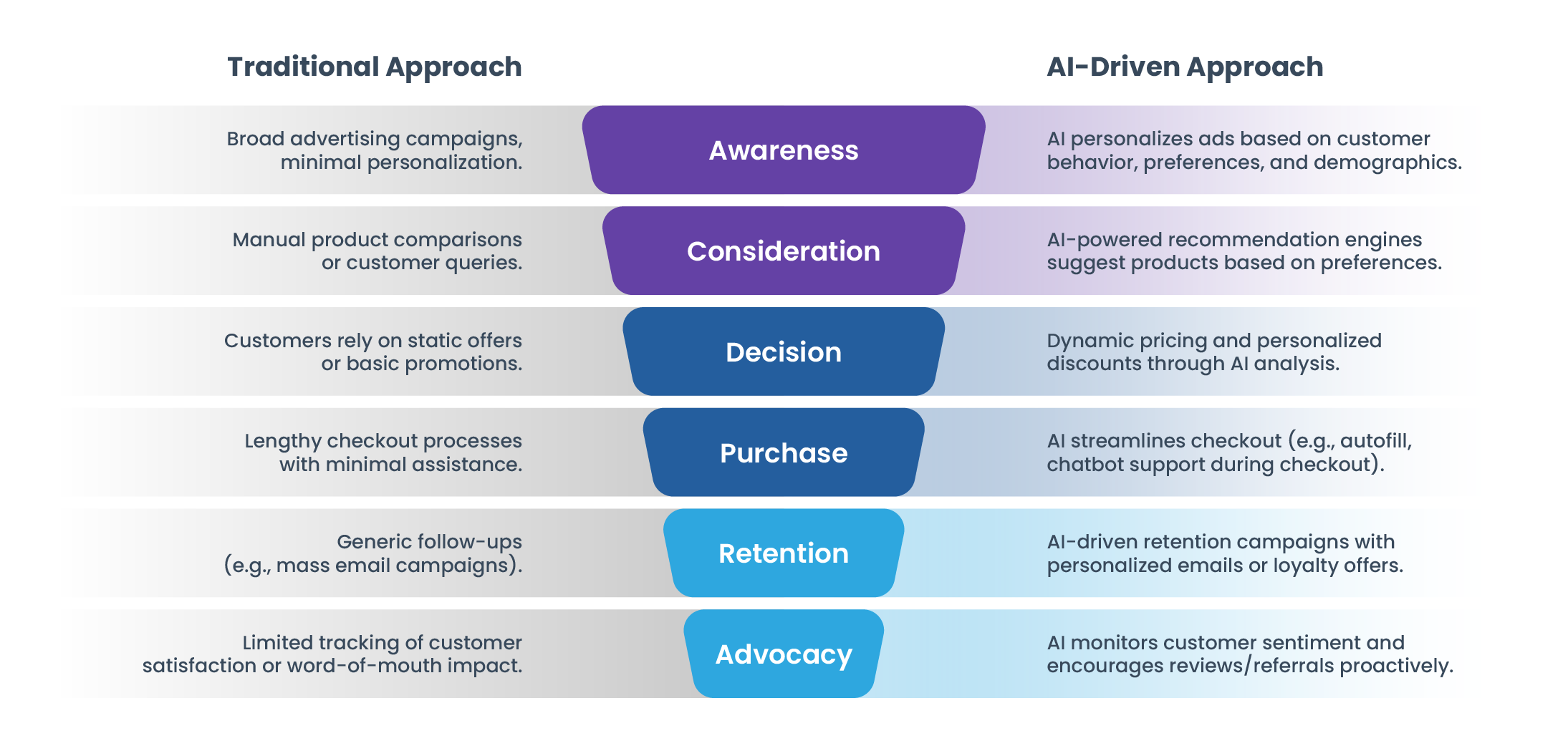
- Journey Mapping: Identify your typical customer paths, from awareness to purchase and retention. Pinpoint where generic messages are currently being sent and where personalization could add significant value.
- AI-Powered Content & Offer Delivery: At each identified touchpoint, deploy AI to deliver dynamic content. This could be personalized product recommendations on your website, tailored email sequences based on browsing behavior, or dynamic ad creatives in retargeting campaigns.
- Feedback Loops and Learning: Implement systems to track how personalized content performs. AI tools can then use this feedback to refine future recommendations and optimize journey paths.
The “data foundation” step, while critical, often hides a significant operational burden: ongoing data hygiene. It’s easy to assume that once systems are integrated, the data will simply flow clean. In practice, data quality is a continuous battle against decay, duplication, and incompleteness. This isn’t a one-time project; it’s a perpetual commitment that demands resources and attention. Teams frequently underestimate the sheer effort required to maintain a reliable data source, leading to frustration when AI models underperform due to inconsistent inputs.
Furthermore, the promise of “AI-powered content delivery” can obscure the fundamental challenge of content creation itself. AI can personalize what is delivered, but it still requires a robust library of relevant, high-quality content variations to choose from. Scaling personalization often means scaling content production, which is a significant, often overlooked, operational bottleneck. Without a strategic approach to content generation, teams risk delivering generic content through a personalized channel, or worse, running out of relevant options entirely.
Finally, while the goal is hyper-personalization, there’s a practical ceiling. Pushing too far can cross the line from helpful to intrusive, leading to what customers perceive as the “creepy factor.” This isn’t just a theoretical concern; it erodes trust and can prompt opt-outs, undermining the very goal of engagement. It’s crucial to prioritize personalization that genuinely adds value and feels natural, rather than attempting to personalize every single interaction. For most small to mid-sized businesses, focusing on a few high-impact, value-driven personalization points will yield better results and mitigate risk compared to an exhaustive, potentially overwhelming, approach.
Practical Implementation: Starting Small
You don’t need a massive budget or a data science team to start. Focus on high-impact, low-complexity initiatives first:
- Email Personalization: Begin with dynamic content blocks in your email newsletters. Use AI features in your email platform to suggest products based on past purchases or recently viewed items. Personalize subject lines based on user segments.
- Website Product Recommendations: If you’re on an e-commerce platform, activate its built-in AI recommendation features. These often require minimal setup and can immediately impact conversion rates and average order value.
- Personalized Ad Retargeting: Instead of showing the same ad to everyone who visited your site, use AI to dynamically generate ad creatives that feature products they viewed or similar items. This significantly improves ad relevance and ROI.
- Automated Welcome Series: Craft a welcome email series that adapts based on how a new subscriber joined your list or their initial interactions with your brand.
What to Deprioritize and Why
For SMBs, the biggest trap in AI personalization is trying to do too much too soon. Today, you should absolutely deprioritize building custom AI models from scratch. This requires significant investment in data scientists, infrastructure, and time, which most SMBs simply don’t have. Instead, leverage the AI capabilities already embedded within your existing marketing platforms (CRM, email, e-commerce). These tools are designed for ease of use and provide powerful personalization features without the overhead of custom development.
Additionally, avoid chasing every “real-time, omnichannel” personalization dream from day one. While aspirational, achieving truly seamless, instantaneous personalization across every single customer touchpoint is complex and resource-intensive. Focus your efforts on the channels where you have the most data and direct customer interaction, such as email and your website. Master these first before attempting to integrate every social media interaction or offline touchpoint into a real-time AI engine. The incremental gains from over-optimizing minor channels often don’t justify the significant effort for an SMB.
Measuring Impact and Iterating
Hyper-personalization isn’t a set-it-and-forget-it strategy. You need to continuously measure its effectiveness and iterate. Key metrics to track include:
- Conversion Rates: Are personalized campaigns leading to more purchases, sign-ups, or inquiries?
- Engagement Metrics: For emails, track open rates and click-through rates. For website content, monitor time on page and bounce rate for personalized sections.
- Average Order Value (AOV): Are product recommendations leading to larger purchases?
- Customer Lifetime Value (CLTV): Over time, hyper-personalization should contribute to higher customer retention and increased CLTV.
Many AI tools provide dashboards to track these metrics, allowing you to see which personalized elements are performing best. Use these insights to refine your strategies, test new approaches, and continuously improve your customer journeys. AI tools for small business marketing

Navigating the Evolving AI Landscape
The field of AI is advancing rapidly, but for SMBs, the core principles of personalization remain constant: understand your customer, deliver relevant value, and measure results. Don’t feel pressured to adopt every new AI trend. Instead, focus on maximizing the capabilities of the platforms you already use or are considering. Prioritize tools that offer robust, integrated AI features designed for marketers, rather than standalone, complex AI solutions. The human element – your strategic thinking and understanding of your brand and customers – remains critical. AI is a powerful assistant, not a replacement for sound marketing judgment. personalized marketing strategies


Leave a Comment