

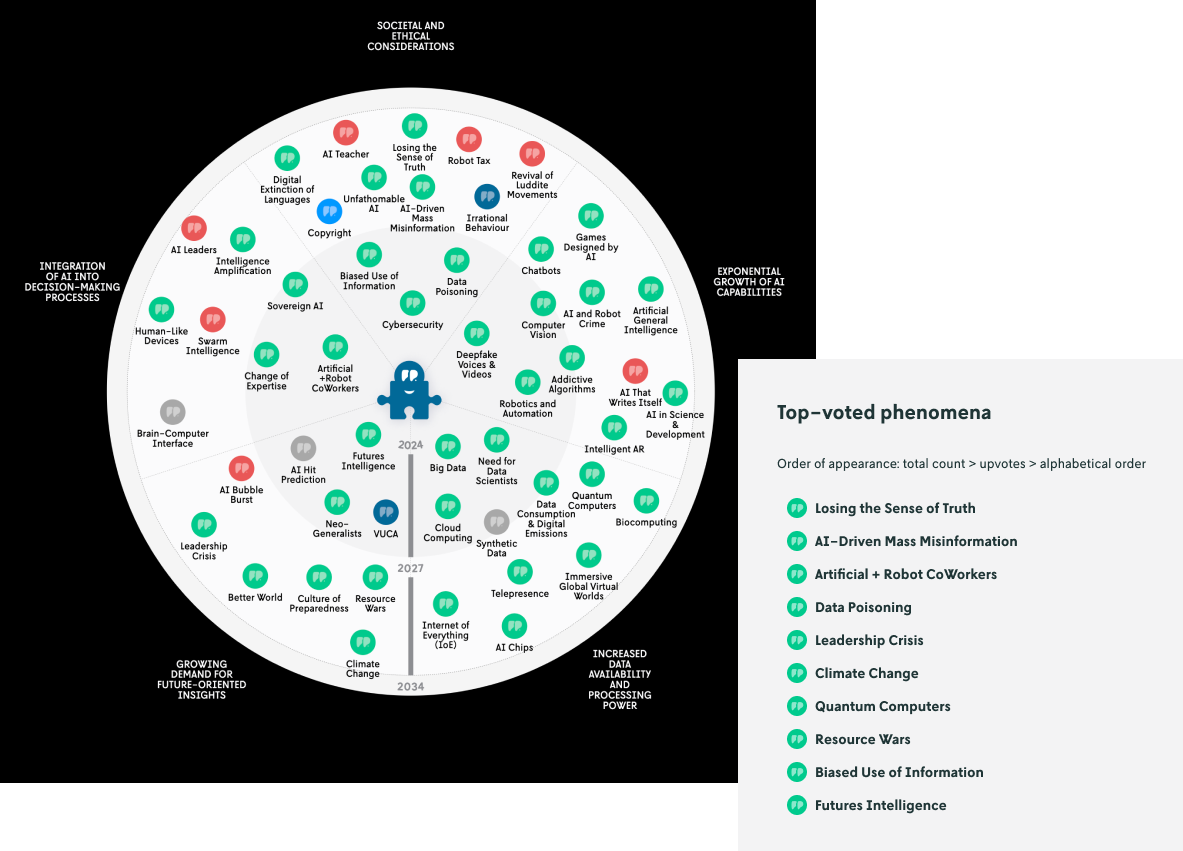
Navigating Tomorrow with AI-Powered Foresight
For small to mid-sized businesses, making informed decisions about the future isn’t a luxury; it’s a necessity for survival and growth. With limited resources and tight budgets, every strategic choice carries significant weight. This guide cuts through the noise, showing you how to practically leverage AI for strategic foresight to identify emerging opportunities, anticipate market shifts, and mitigate risks. You’ll gain actionable insights to allocate your resources more effectively and make future-proof decisions today.
We’ll focus on what works in real-world conditions, helping you prioritize where to direct your efforts and, crucially, what to deprioritize to avoid wasting precious time and money.
What Strategic Foresight Means for SMBs
Strategic foresight isn’t about predicting the future with perfect accuracy. For SMBs, it’s about understanding plausible future scenarios and their potential impact on your business. It involves systematically exploring trends, identifying weak signals, and challenging assumptions to inform your current strategy. This isn’t a theoretical exercise; it’s a pragmatic approach to reduce uncertainty in areas like product development, market entry, technology adoption, and competitive positioning.
The goal is to build resilience and adaptability, ensuring your business can pivot effectively when market conditions inevitably change. It’s about making better decisions today by considering tomorrow’s landscape.
In practice, the challenge isn’t just gathering information; it’s translating foresight into decisive action. Many SMBs fall into the trap of analysis paralysis, where identifying plausible futures becomes an academic exercise rather than a trigger for strategic shifts. This often stems from a natural human resistance to change, even when the data points to an inevitable pivot, or simply the overwhelming pressure of daily operations that push long-term thinking to the back burner.
The real hidden cost here isn’t just a missed opportunity; it’s the erosion of confidence in the foresight process itself. If insights consistently fail to translate into tangible adjustments, teams become cynical, viewing strategic foresight as a time sink rather than a valuable input. This second-order effect makes future efforts to adapt even harder, as the organizational muscle for proactive change atrophies.
For SMBs operating with lean teams and tight budgets, it’s also crucial to understand what to deprioritize. Avoid the temptation to conduct exhaustive, multi-scenario planning for every conceivable future. This level of detail is a resource drain that rarely yields proportional returns. Instead, focus your limited bandwidth on identifying 2-3 critical uncertainties that directly impact your core value proposition or customer base. Prioritize depth in understanding these specific shifts over a broad, superficial scan of every emerging trend. Trying to predict every black swan event is a fool’s errand; building general resilience to a few high-impact, plausible shifts is a far more pragmatic approach.
Where AI Fits into Your Foresight Strategy
AI, particularly in 2026, offers powerful capabilities to augment human foresight, especially for teams with limited bandwidth. It excels at processing vast amounts of data, identifying subtle patterns, and synthesizing information far quicker than manual methods. For SMBs, this means AI can help you:
- Spot Emerging Trends: AI-powered tools can scan news, social media, research papers, and industry reports to highlight nascent trends that might otherwise go unnoticed.
- Analyze Customer Behavior Shifts: By processing customer data, AI can detect changes in preferences, purchasing patterns, or sentiment, providing early warnings or new opportunities.
- Monitor Competitive Landscapes: AI can track competitor activities, product launches, and market positioning, giving you a clearer picture of potential threats or gaps.
- Synthesize Complex Information: Large Language Models (LLMs) can summarize lengthy reports, extract key insights, and even brainstorm potential implications of trends, saving significant research time.

While AI offers speed, its effectiveness hinges entirely on the quality of the data it consumes. What’s often overlooked in the initial enthusiasm is the hidden cost and effort required to clean, structure, and continuously validate input data. If the underlying data is incomplete, biased, or simply irrelevant, the AI’s “insights” will be similarly flawed, leading to a false sense of security or, worse, misinformed strategic decisions. This isn’t just a theoretical problem; it’s a practical drain on resources when teams have to constantly debug or second-guess AI outputs because the foundational data wasn’t robust enough.
Another common pitfall is the subtle erosion of human critical thinking. When AI consistently delivers seemingly coherent summaries or trend alerts, there’s a natural tendency for busy teams to accept these outputs at face value without sufficient skepticism or deeper investigation. This over-reliance can lead to missing crucial nuances that AI models, by their nature, might not detect—especially those requiring contextual understanding, emotional intelligence, or an awareness of unquantifiable external factors. The consequence is a delayed reaction to truly novel shifts, as the team has outsourced too much of its sense-making capacity.
Furthermore, the sheer volume of “insights” AI can generate often creates a new operational burden. While AI excels at pattern recognition, it doesn’t inherently prioritize or translate those patterns into actionable strategic imperatives tailored to your specific business context. Teams can quickly become overwhelmed by a deluge of alerts and reports, struggling to differentiate signal from noise. This can lead to alert fatigue, where genuinely important foresight is buried under a mountain of less critical observations, ultimately hindering, rather than accelerating, timely decision-making.
Prioritizing AI for Foresight: What to Do First
Given limited resources, prioritization is paramount. Don’t try to implement a full-blown AI foresight system from day one. Focus on high-impact, low-effort initiatives that deliver tangible value quickly.
- 1. Define Your Critical Decision Areas: What strategic questions keep you up at night? Is it about product innovation, market expansion, or talent retention? Start by applying foresight to the decisions that have the most significant impact on your business’s future.
- 2. Leverage Existing Data and Tools: Before investing in new platforms, explore the AI capabilities within your current CRM, analytics dashboards, or marketing automation tools. Many already offer predictive analytics or trend identification features you’re not fully utilizing.
- 3. Focus on Specific, Actionable Questions: Instead of broad


Leave a Comment