


Elevating Your Content Strategy with AI
For small to mid-sized businesses, the challenge of consistently producing high-quality, SEO-optimized content that truly engages your audience is constant. Limited budgets and lean teams often mean tough choices. This guide cuts through the noise, offering a pragmatic approach to integrating AI into your content strategy. You’ll learn where AI can deliver the most impact, how to prioritize its use, and what pitfalls to avoid, ensuring your efforts lead to tangible improvements in engagement and search visibility without overstretching your resources.
We’ll focus on actionable steps that allow you to scale content production, enhance its relevance, and free up your team for higher-value strategic work. This isn’t about replacing human creativity, but augmenting it to achieve better results under real-world constraints.
Prioritizing AI Integration: Where to Start
Integrating AI into your content workflow doesn’t mean overhauling everything at once. For SMBs, the most effective approach is to identify your biggest content bottlenecks and apply AI solutions strategically. Start with areas that are repetitive, data-intensive, or require significant time for initial drafts.
- Topic Ideation & Keyword Research Support: AI tools excel at analyzing trends and generating a high volume of relevant content ideas based on target keywords and audience interests. This can significantly reduce the time spent on initial research.
- Outline Generation: Feeding AI a topic and target keywords can quickly produce structured outlines, ensuring comprehensive coverage and logical flow. This provides a solid framework for human writers.
- First Draft Creation: For certain content types (e.g., informational blog posts, product descriptions, social media updates), AI can generate initial drafts, saving hours of writing time. These drafts serve as a starting point, not a final product.
- Content Repurposing: Transform existing long-form content into social media snippets, email newsletters, or video scripts with AI assistance, maximizing the value of your assets.
Focus on one or two of these areas first, measure the impact, and then expand. Trying to implement AI across all content functions simultaneously often leads to fragmented efforts and diluted results for teams with limited bandwidth.
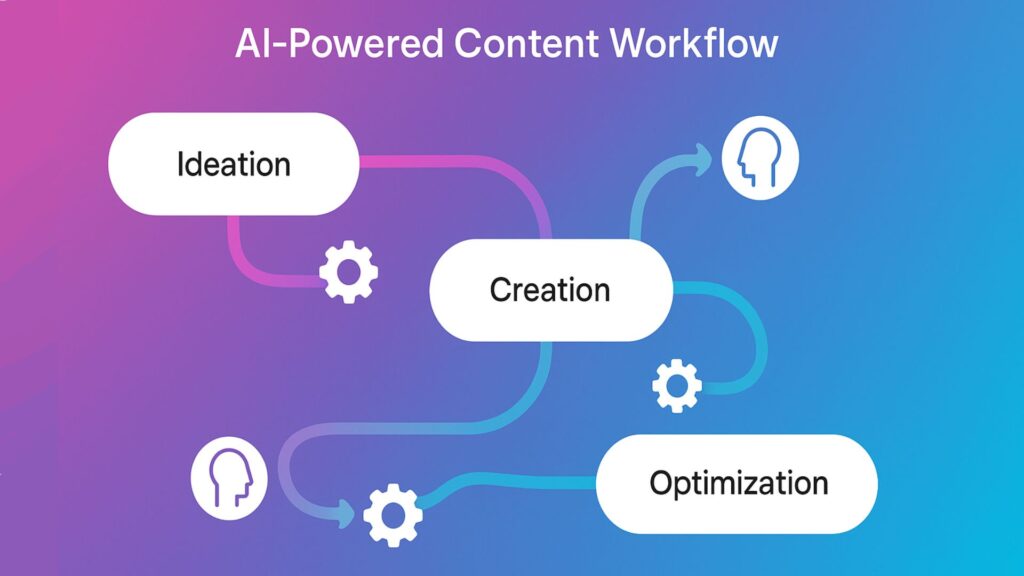
While the initial time savings from AI-generated first drafts are appealing, teams often overlook the downstream burden of human editing and fact-checking. What appears to be a shortcut in creation can quickly become a new bottleneck in refinement. AI output, particularly for complex topics or nuanced brand messaging, rarely arrives as a final product. The effort required to inject true strategic intent, ensure factual accuracy, and align with a distinct brand voice can be substantial, shifting the workload rather than eliminating it entirely. This often leads to frustration when initial expectations of “set it and forget it” are unmet.
Another subtle but significant risk is the gradual erosion of a unique brand voice. Over-reliance on AI for initial content can inadvertently push human writers towards a more generic, statistically probable style. This dilutes the very authenticity and differentiation that small to mid-sized businesses need to stand out. Furthermore, the learning curve for effective prompt engineering is frequently underestimated. Achieving high-quality, relevant output from AI isn’t automatic; it demands iterative experimentation and a deep understanding of how to guide the AI effectively. This initial investment in skill development can feel like a drag on productivity until the team gains proficiency, adding an unseen cost to the integration process.
Crafting AI-Assisted Content for SEO and Engagement
AI is a powerful assistant, but the ultimate responsibility for quality, relevance, and impact remains with your human team. The goal is to leverage AI to produce content that is not only optimized for search engines but also genuinely resonates with your audience.
- Strategic Prompt Engineering: The quality of AI output directly correlates with the quality of your prompts. Invest time in learning how to craft clear, detailed prompts that specify tone, target audience, keywords, desired length, and format.
- Human-Centric Editing: AI-generated content often lacks a unique voice, nuanced understanding, or deep empathy. Your team must refine, fact-check, and inject human insights, brand personality, and original examples. This is where your E-E-A-T (Experience, Expertise, Authoritativeness, Trustworthiness) truly shines through. E-E-A-T guidelines
- SEO Integration: Use AI to identify relevant keywords and semantic entities, but ensure their natural integration. Review AI-generated content for keyword stuffing or unnatural phrasing. Focus on readability, clear headings, and internal/external linking strategies that AI can help identify but humans must implement thoughtfully.
- Engagement Hooks: While AI can suggest compelling headlines or introductions, the ability to tell a story, evoke emotion, or present a truly unique perspective still requires human creativity. Use AI to generate variations, then select and refine the most impactful ones.
What often gets overlooked in practice is the subtle shift in workload. While AI promises to accelerate content creation, an over-reliance on it for initial drafting can inadvertently push the heaviest lifting—the deep research, critical thinking, and unique ideation—from the beginning of the process to the editing phase. This doesn’t save time; it merely reallocates it, often to a point where human editors are left to salvage generic output, leading to frustration and a feeling of constantly “fixing” rather than creating. The real cost here is not just time, but the erosion of your team’s capacity for original thought and the potential for your content to become indistinguishable from competitors who are also leaning heavily on AI.
Another non-obvious failure mode is “AI drift” in brand voice. Without rigorous, consistent human oversight and a clear style guide applied to AI outputs, different team members using various prompts can subtly alter the tone, vocabulary, and personality of your content over time. This slow, incremental dilution of your brand’s unique voice is easy to miss in individual pieces but becomes glaringly apparent across a larger body of work. It’s a second-order effect that undermines the very E-E-A-T you’re trying to build, making your brand feel less authentic and less trustworthy to your audience.
The emphasis on “strategic prompt engineering” is critical, but the practical investment required to develop this skill within a team is frequently underestimated. It’s not enough to simply know that good prompts matter; teams need dedicated time to experiment, document effective prompt structures, and share learnings. Many small to mid-sized businesses, operating under tight deadlines and limited resources, tend to deprioritize this ongoing skill development, assuming basic prompts will suffice. This is a mistake. Without a deliberate effort to refine prompt engineering as a core competency, the AI’s utility will remain capped, and the promise of efficiency will turn into a persistent drain on resources as teams struggle with subpar outputs.
Managing AI Output: Quality Control and Human Oversight
Without robust quality control, AI-generated content can quickly undermine your brand’s credibility and SEO efforts. This is not an optional step; it’s fundamental to a successful AI content strategy.
- Fact-Checking Protocol: Establish a strict process for verifying all facts, statistics, and claims made in AI-generated drafts. AI models can hallucinate or pull outdated information.
- Brand Voice & Tone Review: Ensure the content aligns perfectly with your brand’s established voice and tone. AI can approximate, but human editors are essential for consistency and authenticity.
- Originality & Plagiarism Checks: While modern AI models are less prone to direct plagiarism, always run content through originality checkers to ensure it’s unique and not inadvertently reproducing existing text.
- Subject Matter Expert (SME) Review: For technical or industry-specific content, an SME must review AI-generated drafts to ensure accuracy, depth, and the inclusion of proprietary insights.
- Iterative Feedback Loop: Use the feedback from human editors and SMEs to refine your AI prompts and processes. This continuous improvement cycle is key to getting better output over time.
What to Delay or Avoid in Your AI Content Journey
While AI offers significant advantages, not all applications are suitable for SMBs, especially when resources are tight. Today, you should deprioritize or outright avoid fully automated content publishing workflows that bypass human review. The risk of publishing inaccurate, off-brand, or low-quality content is too high, potentially damaging your brand reputation and incurring SEO penalties. The immediate efficiency gains are rarely worth the long-term costs of rebuilding trust or recovering from algorithmic demotions.
Similarly, delay investing heavily in highly specialized, niche AI tools if your core content needs (e.g., regular blog posts, website copy, social media updates) are not yet consistently met. Many advanced AI features or platforms come with a steep learning curve and significant cost, which can divert resources from more impactful, foundational content efforts. Focus on general-purpose AI writing assistants that offer broad utility before exploring highly specialized solutions for tasks like advanced sentiment analysis or complex content personalization, which often yield diminishing returns for smaller teams.
Measuring Success and Adapting Your Strategy
Implementing an AI content strategy is an iterative process. To ensure it delivers real value, you must track its performance and be prepared to adapt.
- Key Performance Indicators (KPIs): Monitor metrics such as organic traffic growth, keyword rankings, time on page, bounce rate, social shares, and conversion rates for AI-assisted content versus purely human-generated content.
- Efficiency Gains: Track the time saved in content creation workflows. Are your writers spending less time on first drafts and more on strategic editing and ideation?
- Audience Feedback: Pay attention to comments, engagement rates, and direct feedback on content. Does the AI-assisted content resonate as well as, or better than, previous content?
- A/B Testing: Where feasible, conduct A/B tests on headlines, introductions, or calls-to-action generated with AI versus human-written alternatives to understand what drives better engagement.
Use these insights to refine your AI prompts, adjust your human oversight processes, and re-evaluate which content tasks are best suited for AI assistance. Your strategy should evolve as both your team’s proficiency with AI and the AI technology itself mature.

Leave a Comment