


The AI Revolution in SEO: A New Era of Optimization
The landscape of Search Engine Optimization is in a perpetual state of evolution, driven significantly by advancements in artificial intelligence. What was once a domain heavily reliant on manual analysis and educated guesswork has transformed into a data-rich environment where AI tools offer unprecedented capabilities. Today, businesses leveraging AI in their SEO strategies are gaining a distinct competitive edge, moving beyond basic keyword stuffing to sophisticated semantic understanding and predictive analytics.
This shift isn’t about replacing human strategists but augmenting their capabilities. AI empowers marketers to process vast datasets, identify complex patterns, and execute optimizations at a scale and speed previously unimaginable. For MarketingPlux readers, understanding and integrating AI into your SEO framework is no longer optional; it’s a fundamental component of sustainable growth and increased revenue.
Understanding AI in SEO: Beyond Simple Automation
AI’s contribution to SEO extends far beyond simple automation of repetitive tasks. It encompasses machine learning algorithms that can learn from data, natural language processing (NLP) for deep content analysis, and predictive models that forecast trends. These technologies allow for a nuanced understanding of search engine algorithms and user behavior, enabling more precise and effective optimization efforts.
Instead of merely automating report generation, AI can interpret the data within those reports, suggesting actionable insights. For instance, an AI system can analyze user search queries, click-through rates, and on-page engagement metrics to recommend specific content improvements or identify new topic clusters. This level of analytical depth transforms raw data into strategic directives, streamlining decision-making for SEO professionals.
AI for Enhanced Keyword Research and Content Strategy
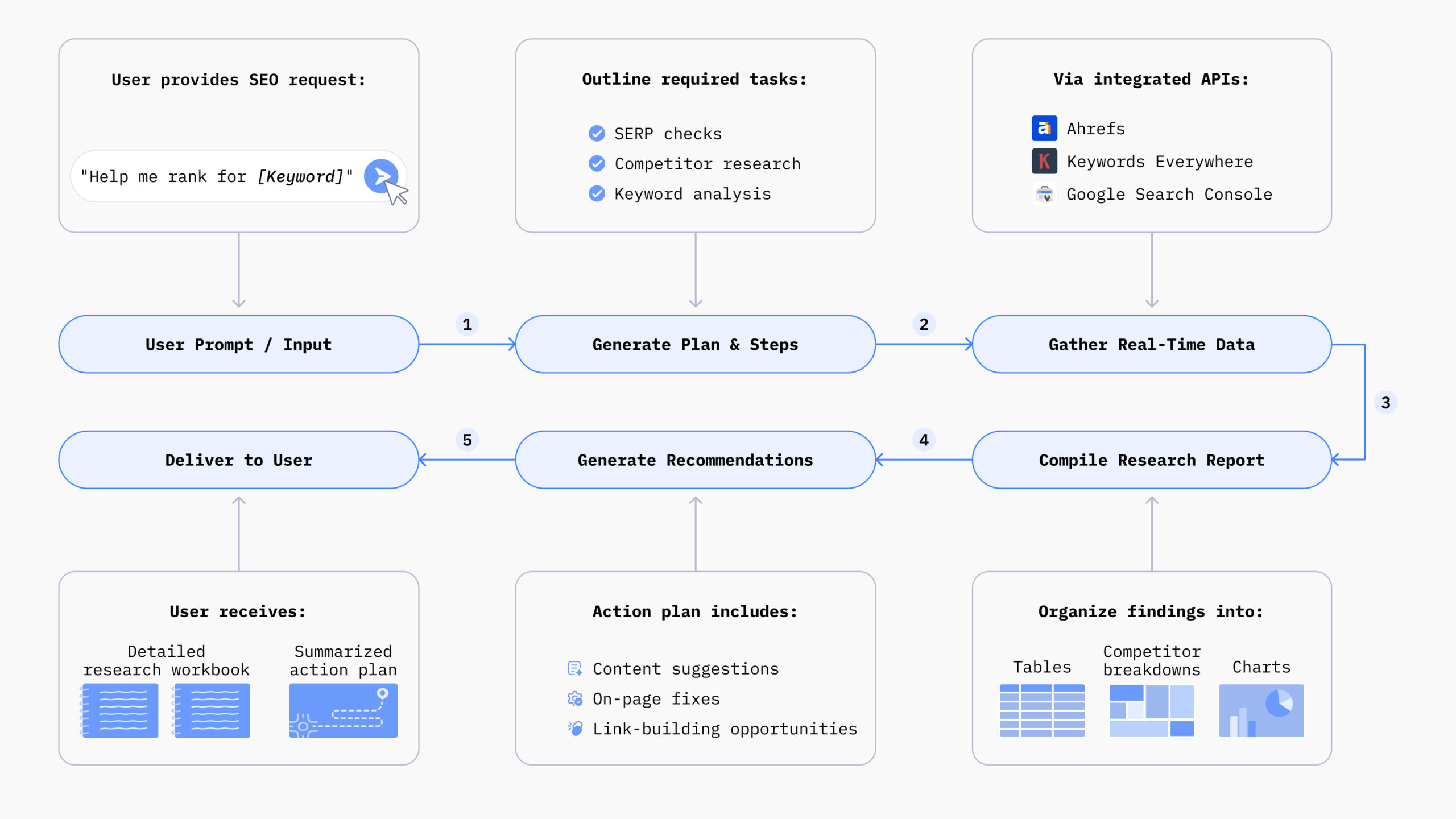
Traditional keyword research often involved manual sifting through tools and spreadsheets. AI-powered platforms now analyze billions of data points, including search queries, competitor content, and user intent signals, to uncover high-value, underserved keywords and semantic clusters. This allows for the creation of comprehensive content strategies that align precisely with what users are searching for and what search engines prioritize.
Furthermore, AI assists in generating detailed content briefs, outlining optimal structure, relevant subtopics, and target entities to ensure content is not only keyword-rich but also semantically relevant and authoritative. It helps identify content gaps, optimize existing content for E-E-A-T (Experience, Expertise, Authoritativeness, Trustworthiness), and even suggest internal linking opportunities to strengthen topical authority. This leads to more effective content that ranks higher and engages users more deeply.
- Identify long-tail and latent semantic indexing (LSI) keywords.
- Analyze competitor content for strategic gaps.
- Generate topic clusters and content outlines.
- Optimize content for E-E-A-T signals.

Optimizing Technical SEO with AI
Technical SEO is the backbone of any successful search strategy, and AI is proving invaluable in this complex domain. AI tools can crawl websites at scale, identifying critical issues such as broken links, crawl errors, duplicate content, and slow page load times far more efficiently than manual audits. They can prioritize these issues based on their potential impact on search performance, allowing teams to focus on the most critical fixes first.
Beyond identification, AI can offer proactive solutions. For example, machine learning models can predict potential server overloads or identify patterns in user behavior that suggest a need for improved site architecture. Some advanced AI systems can even suggest optimal internal linking structures or automatically generate schema markup, ensuring search engines can better understand and index your content.

AI-Driven On-Page and Off-Page Optimization
On-page optimization benefits significantly from AI’s ability to analyze content for readability, keyword density, semantic relevance, and user engagement signals. AI tools can suggest optimal meta titles, descriptions, and headings that not only attract clicks but also accurately reflect content for search engines. They can also recommend content expansions or refinements to improve user experience and dwell time, which are crucial ranking factors.
For off-page SEO, AI excels in backlink analysis. It can quickly identify high-quality, relevant link opportunities by analyzing domain authority, content relevance, and anchor text patterns across vast datasets. Simultaneously, AI is highly effective at detecting and flagging spammy or low-quality backlinks that could harm a site’s ranking, enabling proactive disavowal strategies. This dual capability ensures a cleaner, more powerful backlink profile.

Predictive Analytics and Performance Monitoring
One of AI’s most transformative contributions to SEO is its capability for predictive analytics. By analyzing historical data, current trends, and external factors, AI models can forecast potential shifts in search rankings, traffic volumes, and even algorithm updates. This foresight allows businesses to adapt their strategies proactively, mitigating risks and capitalizing on emerging opportunities before competitors.
AI-powered dashboards provide real-time performance monitoring, flagging anomalies or sudden drops in rankings or traffic immediately. These systems can pinpoint the likely cause of an issue, whether it’s a technical error, a content performance dip, or a competitor’s surge. This immediate, data-driven insight enables rapid response and continuous optimization, ensuring sustained SEO performance and ROI.

The Evolving Partnership: Human Expertise and AI Synergy
As AI continues to mature, its role in SEO will increasingly be one of a powerful co-pilot rather than a sole driver. The most successful SEO strategies will emerge from a synergistic partnership between human creativity, strategic thinking, and AI’s analytical prowess. Human strategists remain essential for interpreting complex AI outputs, setting overarching goals, understanding nuanced market dynamics, and ensuring ethical implementation.
The future of SEO is not about choosing between human or AI, but about integrating both seamlessly. AI handles the heavy lifting of data processing, pattern recognition, and repetitive tasks, freeing up human experts to focus on high-level strategy, creative problem-solving, and building authentic connections with audiences. This collaborative model promises a more efficient, effective, and innovative approach to achieving top search rankings and business growth.



Leave a Comment